Storms River Mouth Bat Cave
Length: 71m | Grade: 5D | Surveyed: 1999-03-29
Peter Swart
17 April 1999
Introduction
As part of our ongoing project to survey sea caves along the southern
coast of South Africa, we obtained permission from the National Parks
Board to visit and survey the Bat Cave near to mouth of the Storms River
during March 1999. The primary aim of our visit was to explore and map
the cave, with a secondary aim of identifying any bats that we could
find.
Access
The cave mouth opens directly into the Storms River mouth gorge, so
access has to be by boat. Ashley Wentworth of Stormsriver Adventures
kindly took us to view the entrance on the boat The Spirit of
Tzitzikama, where we realized that without getting very wet, access was
not going to be simple. Stormsriver Adventures once again came to the
rescue, and supplied us with the tubes used by the Blackwater Tubing
adventures. By strapping a 2.5m long plank to the tubes, we manufactured
a raft that allowed us to paddle and scramble from the boat to the cave
without getting wet.
Work
As the time we had available in the cave was very limited, we split into
two teams. The cave is quite small (74m total length, 41m dry floor), so
Anthony Hitchcock and Stephan Moser were able to survey the cave on
their own. They used a Suunto compass and clinometer, and tape measure.
Joan Vlok and I captured a number of bats and recorded the forearm
length to assist in identification. We also collected all of the bat
parasites we could find. As the National Parks Board expressed concern
over capturing bats using a net, we did not bring any special capturing
equipment, which made capturing the fruit bats very difficult indeed.
Geology
The Storms River gorge is an impressive, deep, narrow gorge, formed in
steeply dipping beds of quartzitic sandstone 7. The river
gorge has formed perpendicular to the strike of the beds, and has left
the walls of the gorge looking somewhat like the side view of a loaf of
pre-sliced bread. The beds dip towards the south at an angle of
approximately 80 to 85 degrees.
At first glance, the Bat Cave seems to have formed by having one of the
quartzite beds removed, but closer examination indicates that cave was
probably formed by the removal of phylitic shale. There are traces of
the shale band in the roof of the cave and towards the back of the cave.
There is also a large shale boulder near the entrance of the cave. Once
the river had cut the gorge through the overlying beds, the softer, more
soluble shale was exposed to both the river water and the sea water at
various stages, and most of it was eventually removed. The boulders in
the floor indicate that the lower material was removed first, and as the
water level dropped, the remaining ceiling rocks could not support their
own weight, and collapsed to form the current floor. The floor at the
back of the cave is probably the true cave floor, while the boulders
near the entrance have fallen from the ceiling, and been jammed part way
down a crack. These boulders have formed a false floor, and the passage
continues below the current water level 1.
Mineralogy
Most of the cave floor is covered by vast quantities of glutinous bat
guano, deposited by the colony of fruit bats that roost in the cave.
This makes examination of the rocks and minerals a little difficult.
Along the southern wall, towards the back of the cave are a number of
hard red/black pillars, and coating cascading down the wall. Where one
of the pillars has broken off, one can see the concentric rings that
form the core of the formation. The pillar emits a dull, metallic sound
when tapped, and probably contains quite a high concentration of iron.
There is another similar formation on the northern wall, near the
entrance. The only other mineral of note was a small pool of mustard
yellow clay in the stream that runs along floor of the cave. The
formations in the cave are still active, and water drips from many of
them.
Biota
Although the cave is relatively uninteresting from a spelaeological
point of view, it more than makes up for this by housing a vast number
of animals. The bats were the prime animal subjects of investigation on
this trip, so we did not collect, nor did we attempt to identify any of
the other animals.
Bats
On approaching the cave, the presence of bats is quite obvious from the
aroma of guano that drifts across the river. There are probably about
1000 bats that live in the cave, about half of which were fruit bats and
the other half insectivorous. There appeared to be one species of fruit
bat, and three species of insectivorous bats.
Megachiroptera
The most obvious population is that of the fruit bats
(Megachiroptera). As we did not have a collecting net with us, we were
only able to capture three of these bats, and the largest of the three
escaped before we were able to measure it. The colony appears to be
Rousettus aegyptiacus. The bat that we were able to measure was
probably a young R.aegyptiacus as the forearm length was only 75.2mm
as opposed to the 90mm+ expected of an adult. 4
Of the two skeletons that were collected, one was an adult
R.aegyptiacus, and the other was probably a juvenile. Apart from the
short forearm length (75.2mm), the dentition of the smaller bat was also
peculiar I?/2 C1/1
P4/3 M2/2?. Two of the upper
premolars were much thinner than the other teeth (\< 1mm diameter), and
were probably milk teeth.
When disturbed, the colony of fruit bats divided into 2 groups. Many of
the bats flew out of the cave, and roosted just under the dripline of
the cave, and on the opposite wall of the river gorge. The remaining
bats stayed in the cave, and clustered together on the ceiling. Each
time they were illuminated by torchlight, they appeared to jostle for a
position in middle of a cluster of bats. If an individual could not get
to the position it wanted, it bit and clawed its way through the group,
until it found a position that it was happy with.
Microchiroptera
When I first entered the cave, I went to back of the cave where most of
the bats were roosting. I saw one Rhinolophus, but it flew off as soon
as I approached it. As Rhinolophus are known to move from cave to cave
as the fancy takes them, this specimen was probably just visiting. The
flurry of activity and noise caused by my entry did not seem to bother
the Miniopterus, and they clung to their perches on the rock. Even
though they were awake, and appeared aware that there was an intruder, I
was still able to pick them off the walls quite easily.
There appeared to be three distinct roosting areas for the smaller bats.
There was a large group of slate grey/dark brown Miniopterus high up on
the north wall, and another group of similar bats high up on the south
wall. Lower down on the southern wall was another group of
Miniopertus, but with much lighter red/brown fur on their heads. They
did not appear to be moulting. As the bat with the lighter brown heads
roosted together, and have a lower average forearm length, I have
tentatively identified them as M.fraterculus.3,4,5 The
larger, darker bats have been identified as the more common
M.schreibersii. 3,4,5
Bat parasites
We caught 10 bats, and after measuring the forearm length of each, we
examined them for parasites. We collected 6 distinct types of parasites,
two in subcutaneous tissue, and four on the body surface.
The largest parasite that we found was a large, hairy, orange and white
wingless fly of the family Nycteribiidae 6. These flies
moved across the bats' bodies very quickly, before burying themselves in
their host's fur. This 'run and dive' behaviour made them very difficult
to catch.
The next largest parasite we found was a winged fly of the family
Streblidae 6. These slender, orange and white-bodied flies
appeared to prefer living the wing or tail folds of the bat. Both the
Streblidae and Nycteribiidae have two simple, very sharp, hook like
claws at the end of each leg. Unlike Nycteribiidae, the Streblidae
have retained their wings, and a number of them stretched their wings
and flew off before they found their way into my alcohol filled phial.
The last of the external parasites that we found was a small gray tick
attached to the back of the head of one of the Miniopterus.
The smallest of the external creatures we found appears to be a larva of
some sort. The creature is 3.3mm long, cylindrical in shape, and covered
in hair like protrusions. We found another example of this creature on
the skeleton of one of the fruit bats. The creature has 12 or 13
segments down the length of its body, with the hair-like structures
protruding from the apex of each segment.
One of the Miniopterus we examined had a very swollen left tragus. On
closer examination, there appeared to be a pimple like growth inside the
tragus itself. The growth was gently squeezed out using a pair tweezers,
and a plug of white tissue, with a dark gray cap emerged from the
enlarged and enflamed tragus. This appears to be an egg case of some
sort. Under closer examination, the lower white section appeared to be
slightly translucent, and a circular structure could be seen inside the
casing.
The other subcutaneous parasite was found in one of the softer, hairless
parts of the face, and very often in the eyelid or tear duct.
Externally, the animal presents itself as a small, slightly raised
crater, less than 1mm diameter at the top and about 2mm wide at the base
of the crater. When this structure was squeezed, a 5mm long, white sac
emerged. This sack is either a larva of some sort, or the female of the
Strebilids, which is known to bury itself in the skin of the bats.
Invertebrates
We did not specifically search for other animals in the cave, but we did
observe a number of invertebrates. The southern wall on which the
Miniopterus fraterculus were roosting, was covered with little moths,
approximately 5mm long. The wings were teardrop-shaped, and the moths
fluttered their wings vigorously as they walked around in circles on the
wall.
There were a number of spiders of all shapes and sizes, but none of them
looked particularly cave adapted. On examining the fruit bat skeletons,
we found that it was covered in 4mm long arachnids. These creatures look
like a cross between a well-fed tick, and a scorpion. They have the
rounded, grey bodies of a tick, and four pairs of legs. The most
striking feature however, are the scorpion-like pincers that emerge from
just the below the head.
Conclusion
The Bat Cave at Storms River Mouth is like many of the sea caves along
the southern coast, having formed when a section of bedding plane was
removed from between the two adjoining beds. The cave is quite short and
does not hold any further spelaeological interest above the water. We
did not explore the submerged section of the cave, but it is unlikely to
extend beyond the length of the upper section.
The large bat colony is well protected from all but the most determined
intruders. The bats provide enough nutrients, and inject enough energy
into the cave environment to sustain an enormous and diverse
invertebrate population. The cave is a veritable paradise for any
entomologist.
Acknowledgements
Our thanks go to John Allen of the National Parks Board for allowing us
to visit the cave, and to Ashley and Kobus of Stormsriver Adventures,
for assisting us in getting to and from the cave. Thanks must also go to
Dr Dave Jacobs of UCT, for assistance in identifying the bats and their
parasites.
Bibliography
-
Allen, John, Pers comm, July 1998
-
Durrheim, G.P., Durrheim, R.J, Martini, J.E.J. (1994) Sea Caves Near
Knysna, South African Spelaeological Association -
Smithers, R.H.N; (1986) Land Mammals of Southern Africa, Macmillan
South Africa, -
Skinner, J.D., Smithers R.H.N; (1990) Mammals of the Southern
African Subregion, University of Pretoria, (key after Meester et al
(1986) -
Stuart, Chris and Tilde; (1997) Mammals of Southern Africa, Field
Guide (Third Impression -
Scholtz, C.H. and Holm, E. (1996). Insects of Southern Africa.
University of Pretoria -
Toerien, D.K. (1973-1976) 3322 Oudtshoorn 1:250000 Geological
Series, South African Government Printer, (1979)
Survey
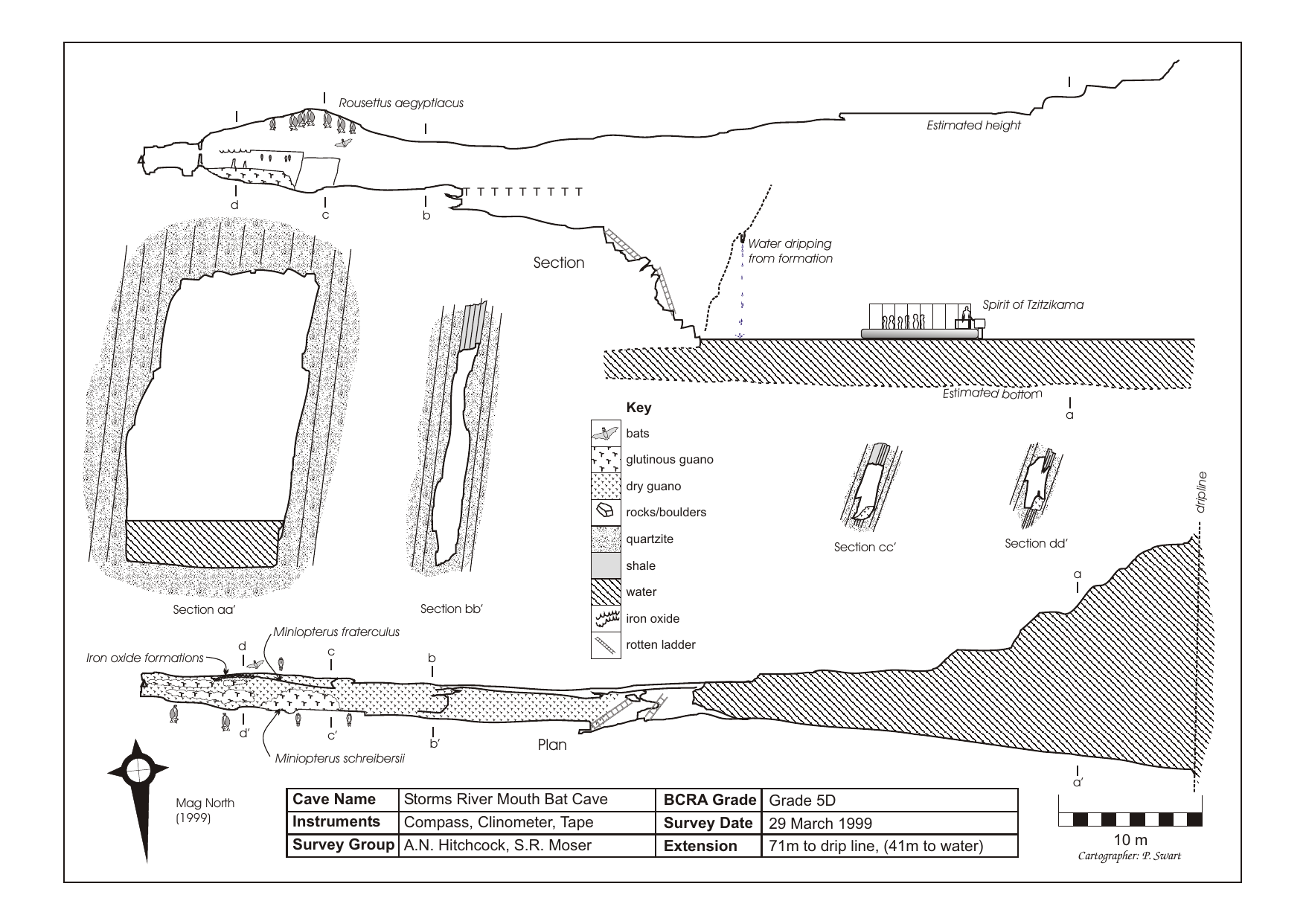
Survey — Storms River Mouth Bat Cave — click image to open PDF