Groot River Mouth Filmy Fern Cave
Length: 55m | Grade: 5D | Surveyed: 2006-01-01
Anthony Hitchcock
I discovered Filmy Fern Cave while exploring the Groot River mouth at the eastern end of the Tsitsikamma Coastal Park. The Groot Rivier forms the border between the Park and Oubosstrand. Peter Swart and I went to the area to explore and map Groot Rivier Guano Cave that was marked on an old forestry map. We completed the survey after which I explored along the eastern bank of the river. I found a slot about 20m above the river level and a few hundred metres from the sea.
Description
A steep scramble leads up to a slot-like entrance about 4m high by 3m wide. The floor slopes gradually into the cave where a body of water extends to the back of the cave. The water at the entrance is particularly disgusting consisting of a soup-like mixture containing amorphous, lumpy ‘algae’, bird droppings and yellow slimy scum on the surface. In this mixture lives a very delicate fern-like water plant hence the name of the cave. The water is crystal clear beyond the first 5m of the cave.
The passage is a narrow angled slot dipping right to left facing in and roughly 3-4m high although the ceiling level fluctuates. The water is clear and cold averaging 1m deep, but 1.5m at its deepest, half way into the cave.
The cave has formed in quartzite rock, but there are some quite large stalactite formations half way into the cave and some at the end. How these calcite formations developed is a mystery, as we have not found any limestone deposits in the area.
The last seven metres is a tight passage above the water line. Access is up a narrow slot into a muddy-low passage decorated with sharp calcite formations. One of the stalagmites has formed and then been eroded by water drilling down through it leaving an interesting section of the core exposed. The cave is 56m long.
Biota
There is evidence of bat guano on rocky shelves and in the passage at the back of the cave, but no bats were seen. Pigeons roost in the ceiling area at least halfway into the cave and we found two adult birds, which had died when they fell into the water.
The filmy aquatic plant material growing in the entrance zone was identified as a member of the moss family called Vescularia galerulata. Vesicularia galerulata occurs in forests throughout tropical and subtropical Africa, including surrounding islands like Madagascar, Diego Garcia and possibly also Malta. In southern Africa it has been collected in forests from the Limpopo Province down to Knysna. Moss expert, Jacques van Rooy says that damp parts of the Tsitsikamma forest are ideal habitats for this species and that at least one other specimen from Mpumalanga was found submerged in a stream.
It is generally recorded as occurring on a variety of moist substrates such as soil, moist rocks, tree and shrub stems under humid shady conditions. The plant material in the cave consists of long, thin, soft green, semi-translucent stems submerged in water. The stems and side branches are adorned with attractive small leaves that give the plant a fern-like appearance. We collected some of this plant material and by default some interesting water life including a crustacean (woodlice) and a hydra (related to sea anemones).
The crustaceans were identified by Professor Charles Griffiths of the Department of Zoology, University of Cape Town, as isopods belonging to the same group as woodlice on land. There is only one known species found in freshwaters in South Africa. It is called Pseudospaeroma barnardi and it is has been recorded from streams at Hout Bay, Hermanus, De Hoop Vlei, Wilderness, upper Knysna Estuary, Keurbooms River and Storms River. The literature suggests that they are found in brackish water and are also tolerant of fresh water.
Species of Hydra have been recorded in standing waters in KwaZulu-Natal and in both slow-flowing and standing waters in the Western Cape. There are only a few records of Hydra in southern Africa, but they are thought to be widespread.
Hydra species are carnivorous, feeding upon small crustaceans, worms and insect larvae, which they capture with their tentacles. Their prey is paralysed by nematocysts and then transferred to the mouth.
References
-
Day, J.A., et al, (2001) ‘Guides to the freshwater Invertebrates of South Africa’, vol. 4 & 5, The Water Research Commission. Pages 76 – 78 and 66 – 67.
-
Hedenas, Lars and Watling, Malcolm C. (2005) Bryophyte flora of Uganda. 5. Hypnaceae (Part 2) Journal of Bryology 27: pp. 153 – 160
-
Van Rooy, Jacques. Pers comm. Principal Scientist, National Herbarium, Pretoria
Survey
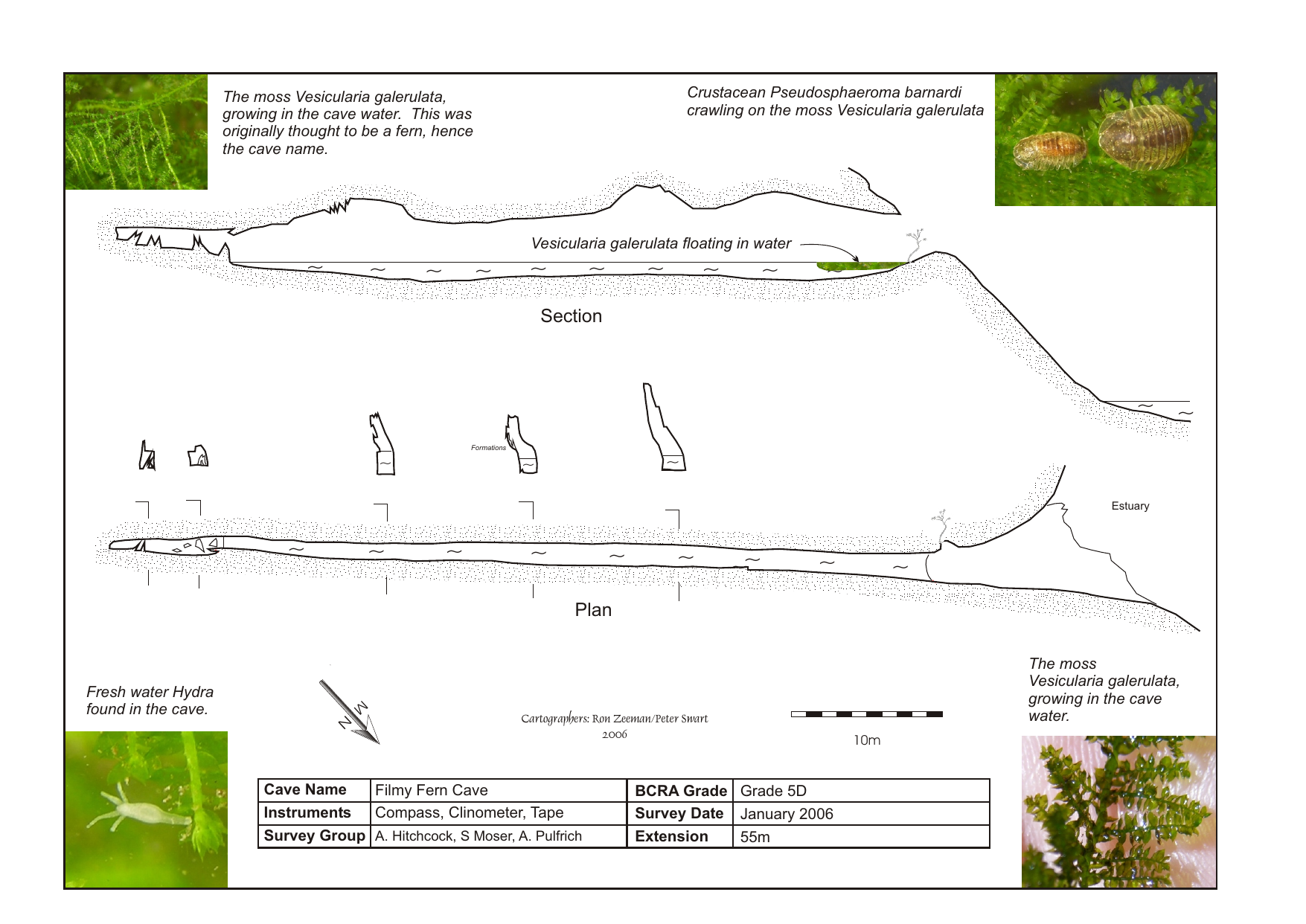
Survey — Groot River Mouth Filmy Fern Cave — click image to open PDF