Boomslang Cave
Anthony Hitchcock and Peter Swart, 6 July 2002
Extension: 600m
Introduction
Boomslang Cave is the best known and most frequently visited cave on Kalk Bay Mountain. It was probably well known and visited before 1900, but there is no written evidence for this. J.C.W. Moore refers to it in his article ‘Caves of the Muizenberg Range’ in the Journal of the Mountain club of South Africa (1944). He says the following: ‘In 1913 Messrs Arderne and Samson wrote to the club claiming the discovery of a cave in 1911 and attached a plan of it to their letter. This plan proves without doubt that it was Boomslang Cave. I have made enquiries, but have been unable to trace anyone who had been to this cave prior to 1911’.
John Meyer’s first entry in his diary dated 3 January 1924 refers to his visit to Boomslang or Alladin Caves. He also referred to it as the Kalk Bay caves. On the 27th of February 1924 he records painting the name Upper Aladdin Caves. He uses this name a number of times and then changed to the name Boomslang in 1928.
His diary entry on the 27th February shows that he began to name sections of the cave. Names such as 'The Long White Hall', 'The Black Chamber', 'The Muddy Passage', 'The White Chamber', 'The Big White Room' and 'The Big Round Hall' are mentioned.
On the 1st March he measured the ‘Long White Hall’ to be 100 feet long and from 7 to 10 feet wide. He also discovered and painted the name ‘The Ventilator’ and ‘Danger’ next to the hole leading into the ‘Long White Room’ or Cathedral as it was later named.
Description
See virtual tour.
Survey and Exploration
The first survey by Arderne and Samson (1911) sadly cannot be found. A reasonably good survey was published in the Cape Argus newspaper in 19/10/1923. In the article it is refered to as Alladin's Cave.
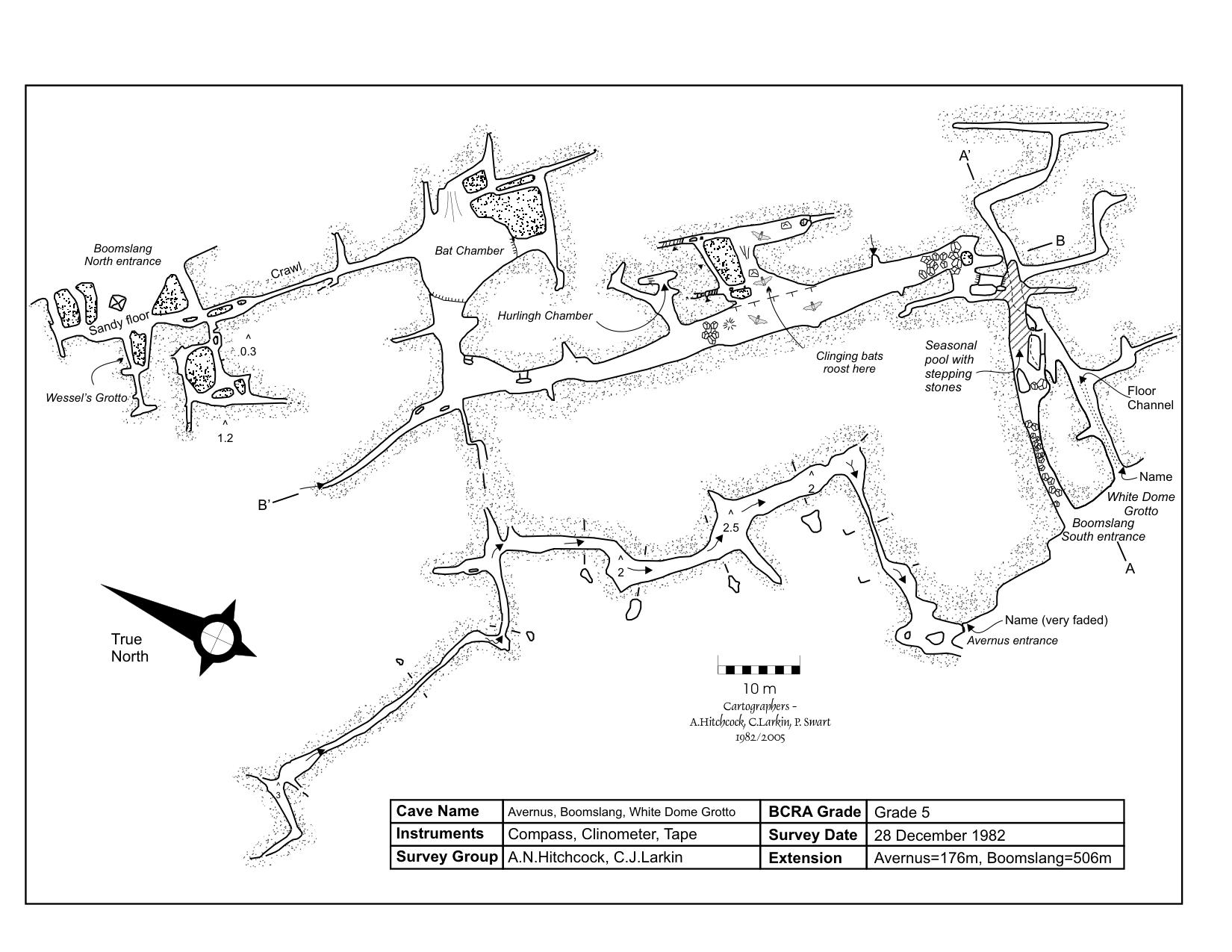
In June 1982, Anthony Hitchcock and Dave Eckles surveyed Boomslang and White Dome Grotto. They noticed water falling down a slot in the ceiling of the latter and located the source in Boomslang cave, part of which lies above. The large pool in the entrance corridor of Boomslang overflows along a narrow passage and disappears between rocks in the floor into the cave below. No attempt was made to open the connection as the survey shows it clearly. The survey also shows that passages in Boomslang and Avernus cave come to within approximately 4 meters of each other on the plan. The vertical difference is not known, but cannot be much. Attempts to connect the two caves have been fruitless and suggest that the passages be on different levels. The upper vaults near the ventilator were not surveyed.
There appear to be passages at a higher level on either end of the side chamber off the Cathedral Chamber, but these were not explored, as access requires a maypole or ladder. A network of minor passages radiate from the 'Round Hall'. Most of these are short and reconnect with the chamber, but one leads off to the exit. Two low systems of passages were explored and surveyed near the exit. One on the left as you turn towards the exit and the other is located within the exit shelf. This series of passages is called 'Wessel Grotto'. The length of the cave is difficult to accurately determine as it has so many interconnecting passages and it depends how you measure these. The total length was measured to between 500 and 600m.
Further discoveries may be made if the upper vault and boulder complex near the ventilator is thoroughly explored?
Fauna
The upper reaches of the Cathedral Chamber are home to a colony of insectivorous bats (approximately 200-300 Miniopterus schreibersii). These bats usually roost in the cave over winter, and are not found in the summer months. It is unfortunate that they get disturbed so often by the numerous visitors and by the occasional fire that is made in the chamber. A few bats are sometimes found in the 'Round Chamber' (Rhinolophus sp.). The cave is home to large numbers of cave crickets, harvestmen and various spiders. Cave shrimps and planaria are usually found in the pools.
Safety
Boomslang is regarded as a safe cave and is often used as an introductory cave for initiates. Safety is relative to what you do while in the cave so it should not be regarded as a place where accidents cannot happen. There are some very tight passages where people can get stuck and smooth boulders to slip on.
The main danger is if people attempt to explore the ground above the cave at or near the Ventilator. Loss of footing could result in a 15m fall down the ventilator into the cave. There is at least one other skylight entrance into the Cathedral Chamber located in difficult terrain. Entrance through these skylight entrances should be avoided due to the possibility of erosion and causing the area to become unstable. There is also the possibility of disturbing the bat colony.
This large cave is home to many very species of animals, from bats to invertebrates. The many visitors to the cave put an enormouse amount of pressure on the cave life.
Please be aware that any pollution you bring in to the cave could wipe out sensitive populations of cave dwellers.
Agumented extract from Fire Protection Services booklet
After Muizenberg Cave this is the best known cave on the mountain and has been visited by thousands. It penetrates the mountain from South to North and is 480 feet in length. Entering from the South, one follows a broad passage leading to the lofty Cathedral Hall which is 100 feet in length and has a pulpit on one side and an organ gallery on the other. The passage continues for 130 feet and then branches; the right-hand branch, indicated by two arrows, is followed and leads into a large chamber in which bats are usually present. From this point the passage is followed North to its exit 120 feet away. Forty feet from the exit the notorious narrow place has to be negotiated, and this is where the thin laugh! In spite of new discoveries this cave remains the finest on the mountain. Only about 60 feet of crawling has to be done.
Survey Plans
Photos
![Boomslang Cave - Bats Halls [JCW Moore Collection]](Photos/Boomslang Cave - Bats Halls [JCW Moore Collection].jpg)
![Boomslang Cave - Cathedral Hall [JCW Moore Collection]](Photos/Boomslang Cave - Cathedral Hall [JCW Moore Collection].jpg)
![Boomslang Cave - Cathedral Hall[JCW Moore Collection]](Photos/Boomslang Cave - Cathedral Hall[JCW Moore Collection].jpg)
![Boomslang Cave - Catherdral Hall [JCW Moore Collection]](Photos/Boomslang Cave - Catherdral Hall [JCW Moore Collection].jpg)