Helderberg 3 Fruit Bat Cave
By Peter Swart, May 2007
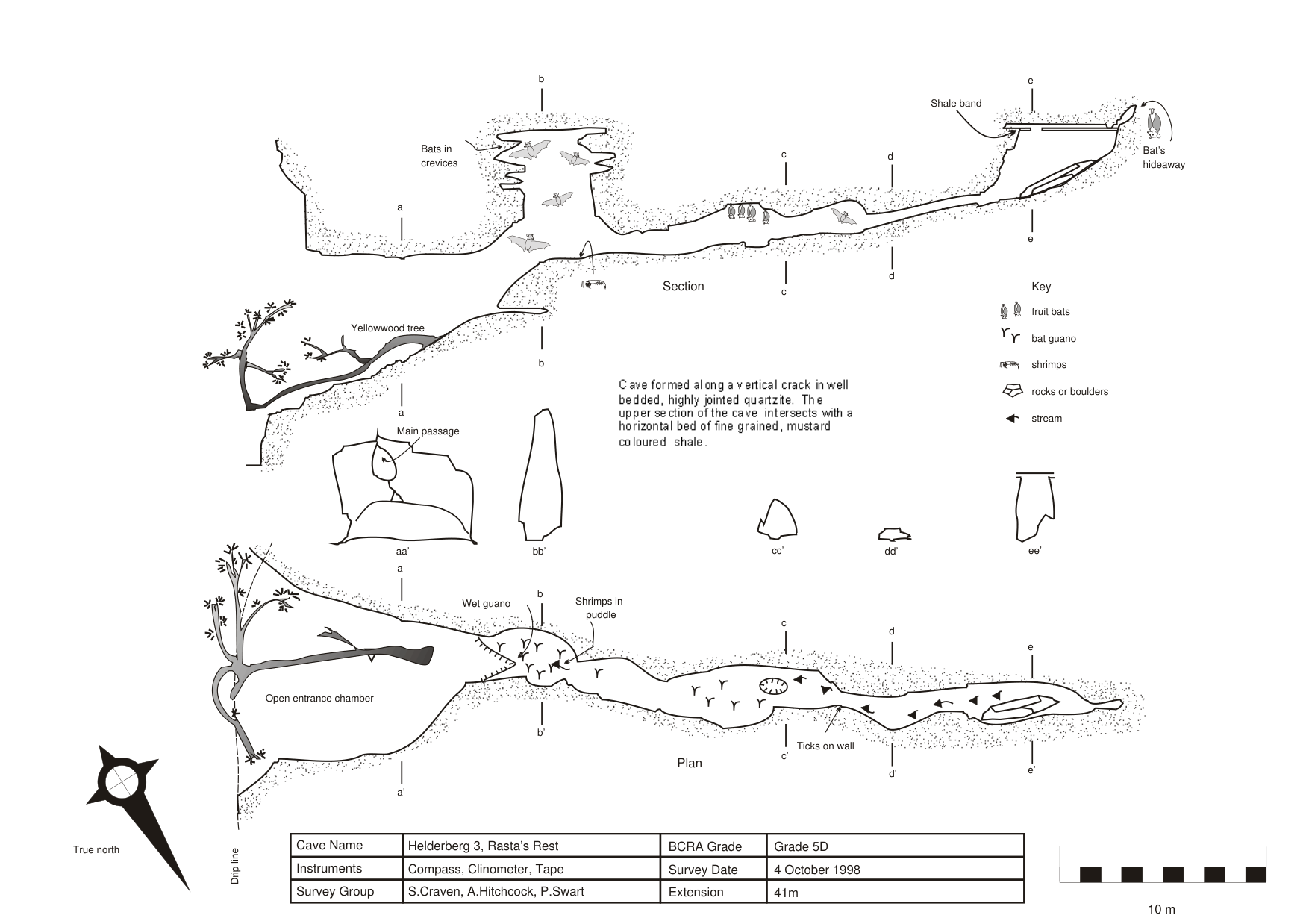
The cave is a 40m long crack in the well bedded, highly fractured Table Mountain Sandstone of Porcupine Buttress. The entrance to the cave is approximately 10m high by 10m wide, and narrows to a small terminal tube, less than 30cmx30cm.
The upper section of the crack crosses a thin, horizontal bed of mustard coloured shale. This layer is very clearly visible in the terminal chamber. The first chamber has a number of shelves in the upper section, one of which probably corresponds to the shale bed found in the terminal chamber. The floor of the cave is covered by wet bat guano in the entrance chamber, and by damp, compacted mud in the second and third chambers. The floor of the terminal chamber is also covered in crushed shale and small stones.
The most important inhabitants of the cave are the fruit bats that live in all sections of the cave. When we went into the cave, most of the bats were in the first two chambers, and the large glutinous mass of guano in the first chamber indicates that the bats tend to stay near the entrance. While we were surveying, a few bats flew into the cave, and clustered in small pocket right at the back of the cave, 40m from the entrance.
Along with the bats come their parasites. One of the fruit bats we examined was host to a fast moving, wingless fly. This fly is a member of the family Nycteribiidae, and is a blood-sucking ectoparasite normally found on bats.
Another fruit bat was covered in relatively large scars. Most of the scars appeared to be dry, but two of these scars had large, white centres. These white centres appear to belong to another ectoparasite of the family Streblidae. These organisms embed themselves in the subcutaneous tissue of the bat, and degenerate into sac-like cyst.
Although we did not carry out an exhaustive search for animal life, we did find a number of small invertebrates. About 20m from the entrance of the cave, we found a number of ticks on the passage wall. We also found spiders in cracks in the walls, and small (4mm long) shrimps in the stream.