Plettenberg Bay Oumatjie Cave
Region: Caves West of the Tsitsikama National Park
Oumatijie Cave
Description
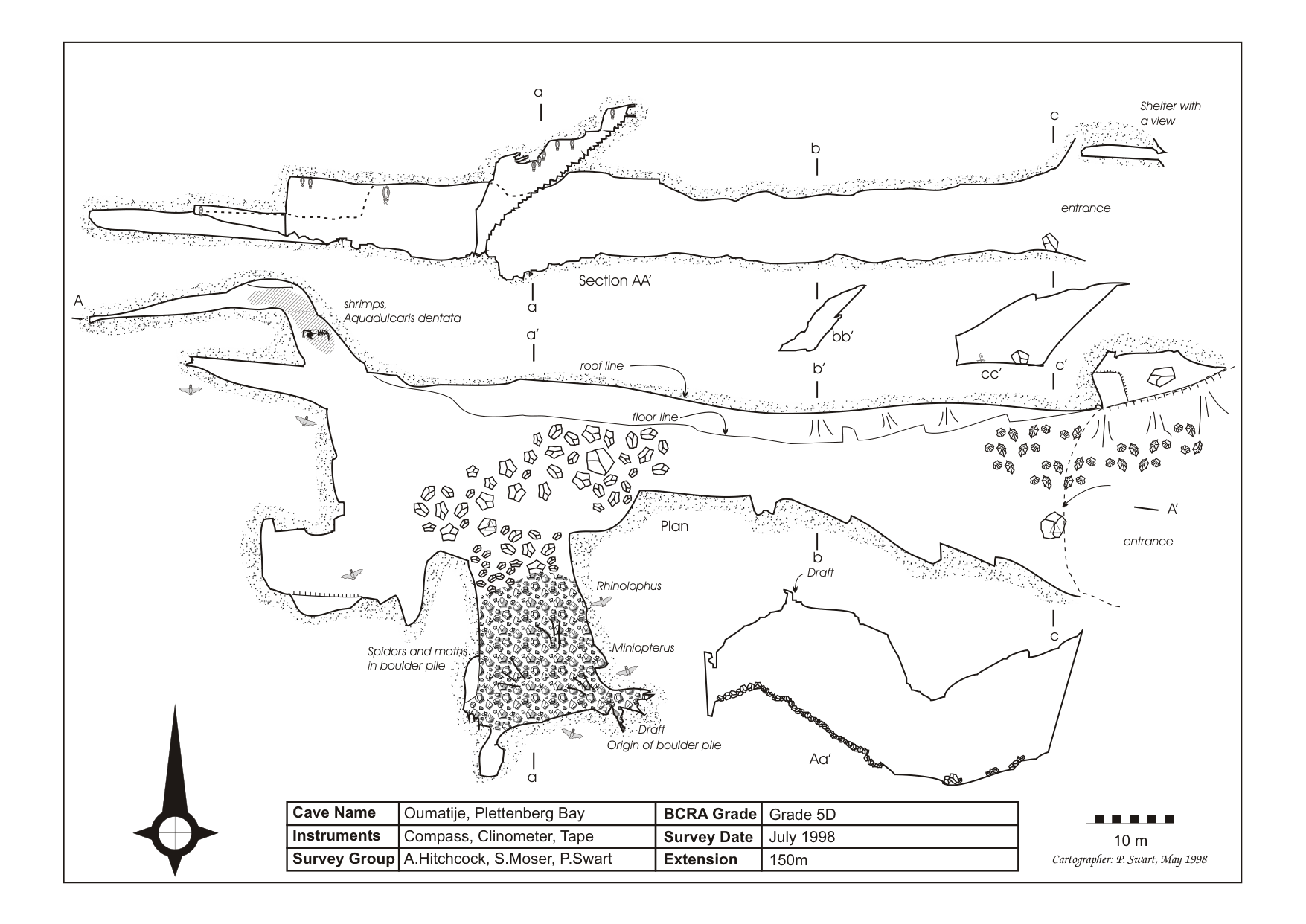
The entrance to Oumatjie Cave is a high, sloping slot, that narrows considerably during the first 20m of passage. The entrance passage then opens into a large chamber, with guano covered boulders on the floor. Off to the left is another chamber partially filled by a scree cone of very sharp boulders. These seem to have poured from a hole in the far southwestern corner of the cave. Although the passage at the top of the boulder pile is not easily negotiable, the draft that we detected indicates that there may be an upper entrance.
Biota
Oumatjie Cave is home to a large colony of bats. At least 3 species of insectivorous bats roost in their hundreds in both the main chamber, and in the scree-slope chamber. During our visit, we collected, measured and released Rhinolophus clivosus, Miniopterus schreibersii and Miniopterus fraterculus. The Miniopterus species were identified by both measurements of live bats, and from carcasses collected from the floor of the cave.
A lady by the name of Elizabeth, who works at the local community centre, said that when she was young, they used to remove bat guano from the cave. She also said that they used to burn shells in the entrance of the cave, but could not remember why this was done.
The remaining guano in the cave provides a suitable habitat for a number of invertebrates. With the exception of a spider, and an amphipod, all of the beetles, spiders and other invertebrates that we observed did not appear to be cave adapted. The spider's body was less the 1mm in diameter, and white in colour, with long spindly legs. Norma Sharrat examined the spider and identified it as Smeringopine pallidus, one of the Daddy-long-legs spiders, of the family Pholcidae. A number of species of this family has been found in caves and animal burrows. (2)
A small stream issues from the back of the cave, and in one of the pools in the stream we found a large number of small shrimps. Dr Charles Griffiths identified these amphipods as Aquadulcaris dentata. These animals have been collected only from the Cape Peninsula before.
Survey Plans
Photos
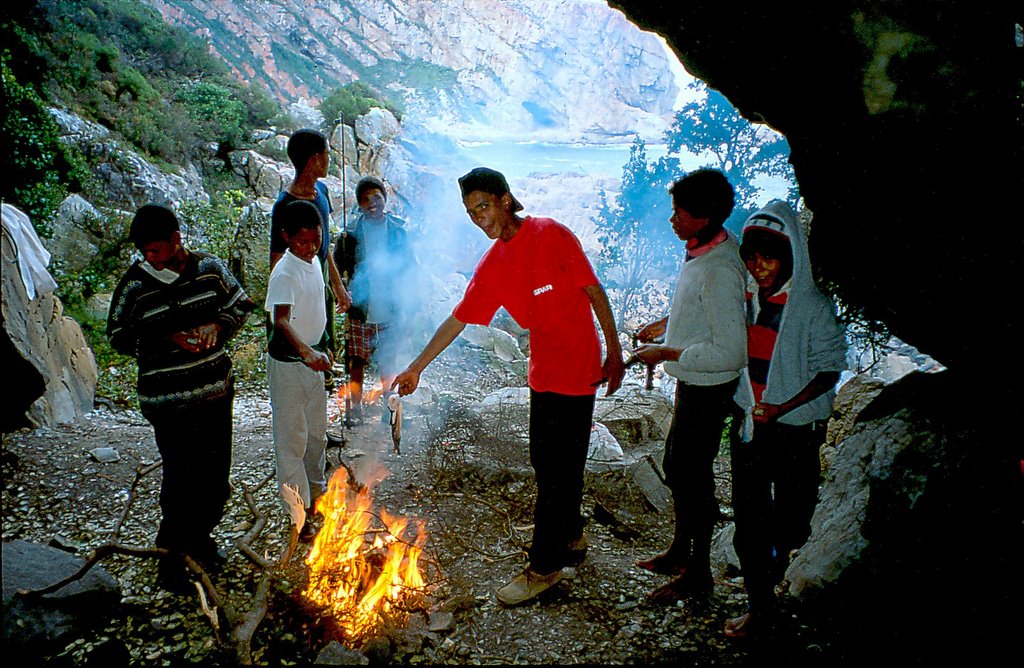
![Oumatjie Cave Plettenberg Bay Anthony and Reece looking for Paramalita[Photo][P.Swart]](Photos/Oumatjie_Cave_Plettenberg_Bay_Anthony_and_Reece_looking_for_Paramalita[Photo][P.Swart].jpg)
![Oumatjie Cave Plettenberg Bay Cave entrance[Photo][P.Swart]](Photos/Oumatjie_Cave_Plettenberg_Bay_Cave_entrance[Photo][P.Swart].jpg)
![Oumatjie Cave Plettenberg Bay Caves light writing[Photo][P.Swart]](Photos/Oumatjie_Cave_Plettenberg_Bay_Caves_light_writing[Photo][P.Swart].jpg)