Plettenberg Bay Gilead Cave
Region: Caves West of the Tsitsikama National Park
Gilead Cave and Oumatjie Cave, Plettenberg Bay
Introduction
During the 1998 winter holidays, the Hitchcock Family, Stephan Moser, Joan Vlok and I spent a few days exploring the coastline around Plettenberg Bay and Nature's Valley.
Our highly scientific exploration technique involved choosing cave-like place names on a 1:50000 map, then picnicking in the area, in the hopes that cave entrances would present themselves for exploration. While we were attempting to get to a place called Neusgate (Nostrils), we came upon a house on a cliff, and met the owner, Mrs Dawn Leggat. She informed us that although there was no known cave in the vicinity of Neusgate, there was a cave that her son had discovered on her property. A photograph of Neusgate revealed that it is a prominent outcrop of rock, which bears an uncanny resemblance to the nose of at least one of the members of our survey party! Mrs Leggat kindly gave us permission to visit her cave, and sent us off in the right direction. After we had surveyed the cave, we popped in to thank Mrs Leggat, and were invited in to see the chocolate factory on her dining room table!
The next day, we made our way across to the Kranshoek Griekwa Nedersetting, where we were directed to a bay marked on the map as Ghanopad. The locals know the bay as Oumatjie, as an old lady used to live on the cliff above the bay. Here we were rewarded with a splendid cave, and two large arches.
While we were preparing to survey the cave, a number of the local children came clambering up to the entrance, each carrying a dismembered tentacle of a large octopus that they had caught. While we dined on peanut butter sandwiches, the boys plunged their catch into the flames of a roaring fire that they had built, and within minutes, their lunch was well charred, and consumed with much relish.
Gilead Cave
Geology
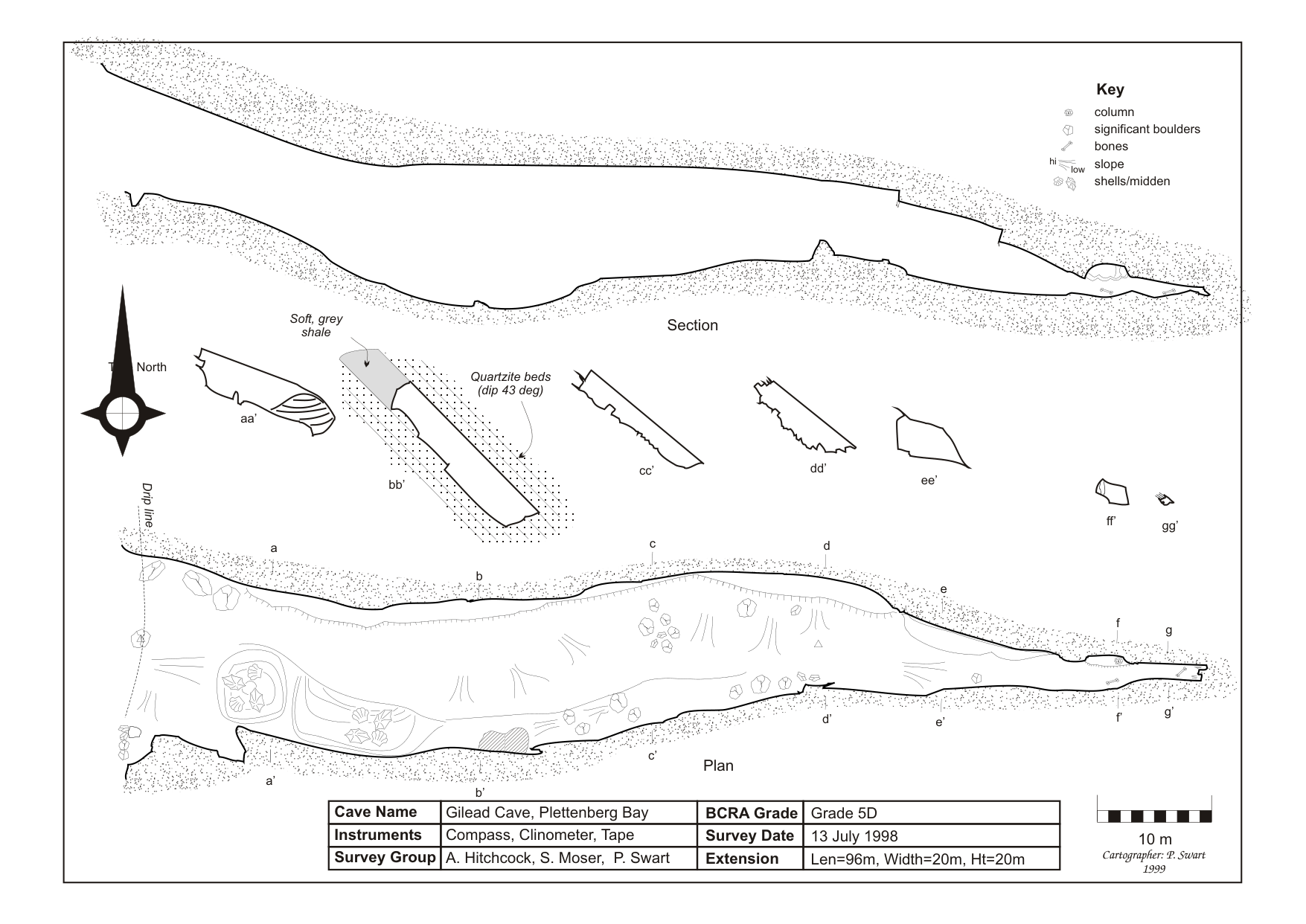
A few kilometres to the west of Robberg, the coast is characterized by a narrow, rocky strip at sea level, backed by 80m to 100m high quartzite cliffs. The quartzite beds dip steeply towards the sea in the south, with the strike running approximately parallel to the coast. The beds have been differentially lifted along joints that run parallel to the dip, and give the impression of large, steeply sloping steps.
Gilead Cave was formed when a light gray shale band was eroded from between two quartzite beds. The remains of the shale band can be seen on the northern ceiling of the cave (see cross section bb'). The north wall/floor of the cave is a series of quartzite slabs, covered in a light grey powdery dust, and littered with rubble that has fallen from the ceiling.
Minerals
Most of the visibly interesting minerals occur towards the back of the cave. White crystals and short silica stalagmites have formed along joints in the ceiling, while a bank of dark red clay has formed in an alcove in the northern wall. A 1m high column of red clay, which reaches to the ceiling, tops a bank of the same red clay. The clay is possibly allophane (Durrheim et al, 1994).
Biota
Although we did not search the cave for small animals, we noted signs of porcupines and bats in the cave. The floor of the cave was littered with quills and we found a small pile of bat droppings on the ledge that runs along the northern wall. A number of 3cm long, white hairy moth caterpillars were feeding on the bat droppings. These caterpillars appear similar to the ones that occur in Woolly Worm Cave at De Hoop.
Archaeology
There are two large shell middens at the entrance to the cave, and judging by the size of the shells in the middens, they don't make limpets the way they used to. Mrs Leggat showed us a small digging weight, and parts of a stone tool that they had found in the cave. Apparently (Leggat pers comm) the slanting floor of the cave made it unsuitable for habitation, so the cave was just used as a stop over, or shelter. There were also a number of fossilized bones on the floor of the cave, all baring fairly new teeth marks on them.