Devils Pit Cave
Anthony Hitchcock and Peter Swart, TBD
Extension: 125m
Introduction
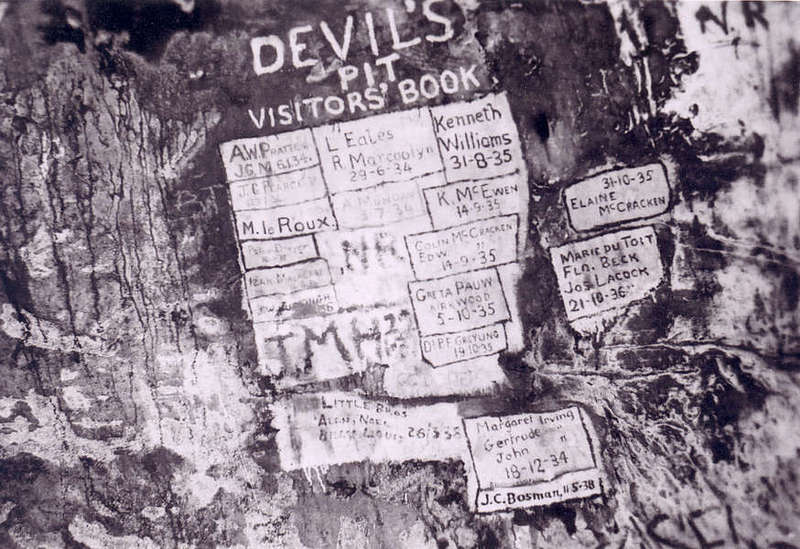
John Meyer records that he found and named Devil’s Pit on the 24th August 1933. He named it after the shape of a large rock located on the slope above the cave. He even went as far as painting eyes and mouth on the rock. This can be seen on some of the old photographs. TBD
Description
It is well known for its dangerous 15m shaft located near the main path along the top of Cave Peak. For this reason a barbed wire fence was erected around the area probably sometime before the 1970’s. Devil’s Pit is a small complex cave with three entrances. The top entrance formed when parts of the ceiling of the chamber collapsed. Prior to this there must have been a lofty chamber with a thin roof. There are still large weathered boulders forming a partial covering with the main access to one side. Well-established knarled forest trees adorn the top entrance and partially hide it. Access to this entrance is by clambering down amongst the boulders and there you will find a sandy slope dropping away into the hole. A sturdy tree gives support to those peering down the hole. Care must however be taken as there are reports that people have slipped and fallen down this shaft. A small 3m hole is located behind this entrance, which does not lead anywhere, but be careful not to fall into it.
[TBD Euan pic]
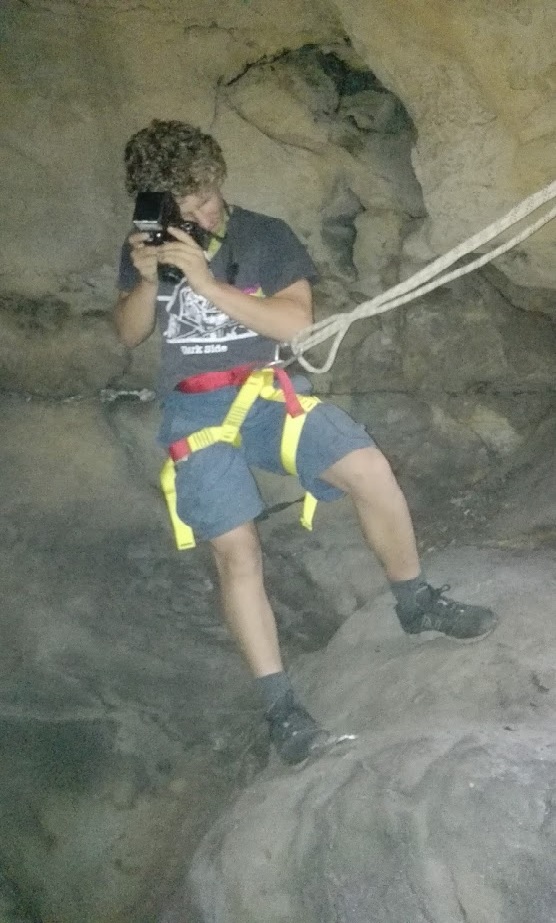
The Devil’s Pit system formed in a low rock ridge, which drops vertically to the south. A second entrance to the shaft developed halfway down the cliff. This is easily found by following the path past the western side of the cave to the lower slope. A minor cliff sheltered by forest trees is where the other two entrances are located. The second entrance is a fairly large slot that allows access to the shaft about 10m from the floor. The rock has become very smooth from all the visitors so be careful. It is recommended that ropes be used to gain access to the cave from entrance 1 and 2.
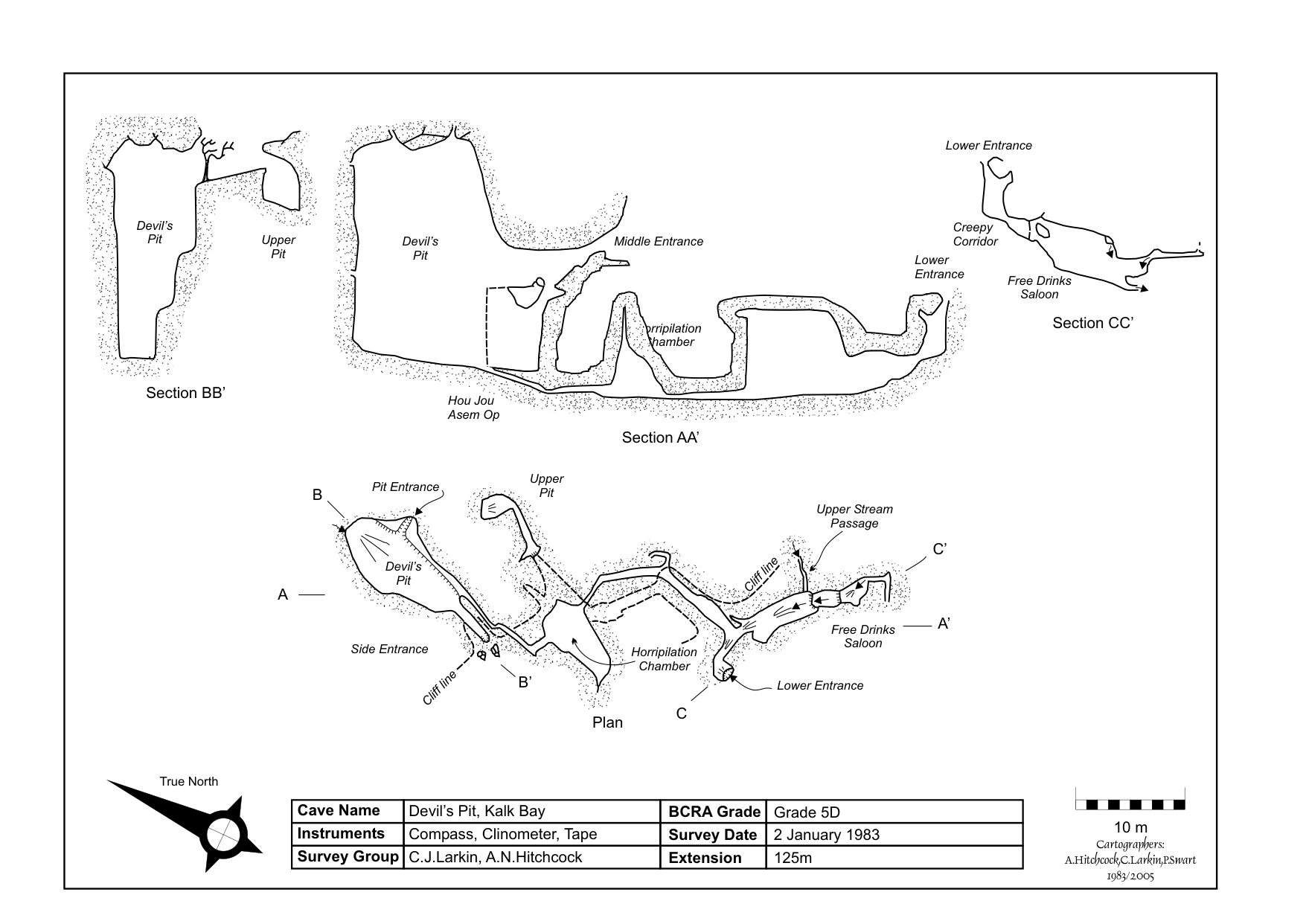
The third entrance is found at the base of the cliff a little further to the southeast. It is a small hole situated between some boulders at a low point along the base of the cliff. A short constricted decent leads into a low passage that divides into two. The right hand passage enters ‘Free Drinks Saloon’, which was named by John Meyer because it provides water throughout the summer. The floor slopes gently downwards and is strewn with small boulders. Two minor passages carrying small streamlets feed in from the back of this small chamber. The water disappears between the rocks at the lowest point in this chamber and it appears that there could be more passage if the rocks were removed. This would however be a major undertaking.
The way on is along the left-hand passage that initially is a lofty corridor, but soon becomes a sandy crawlway that leads to ‘Horripliation Chamber’. This is a 8 x 5m chamber with its floor covered by sand and silt washed in from the Shaft. A short tight squeeze through ‘Hou You Asem Op’ (Hold Your Breath) allows access to the bottom of the pit. Erosion of the path near the cave has resulted in sand and silt washing down the shaft and blocking access through these lower passages. There is no apparent continuation of the cave beyond the pit.
Survey and Exploration
Anthony Hitchcock and Chris Larkin surveyed the cave on the 3rd of January 1983. The survey showed Devil’s Pit to be a small system a little over 100m in length. The most promising passages were found in Free Drinks Saloon. [TBD picture] There is definitely drainage through the floor of this chamber, but the potential for more passage is uncertain and will require the removal of lots of rubble.
Fauna
The usual cave crickets and spiders.
Safety
The stability of the weathered rock around and over the shaft is not known and must be assumed to be unstable. Access to the top of the pit is smooth and slippery. A number of people have been rescued after falling down this hole. The second entrance halfway down the shaft is also smooth and slippery. This entrance suggests the possibility of free climbing to the floor 10m below. The smooth sloping shelves make this a dangerous proposition.
The third entrance is the easiest, but could be unstable at its entrance. The tight passage between ‘Horripilation Chamber’ and the pit is difficult and it is possible someone might get stuck in it. This cave must be put on the priority list for callout in a search and rescue scenario.
Extract from Fire Protection Booklet
A hundred yards further on the path passes a large rock on the right and the pit is concealed in some trees on the left. This rock is called Devil's Head and, although it has not got the aquiline features of Mephistopheles, as depicted in Faust, it is grim enough. For thousands of years it has watched over the great hole beneath it. The pit which is 45 feet in depth can be viewed from a rock on the west side. Some of the rocks round the top of the pit are badly weathered and loose, making this vicinity decidedly one to avoid. A protective fence has been erected to prevent the unwary from making an inadvertent and probably fatal plunge into the nether regions. The pit is 30 feet wide at the top; tapers down to 5 feet about 15 feet lower down and then opens out again. It is 18 paces in length at the bottom and is oblong. Half way down the slope on the west side a platform, 27 feet above the bottom, allows a good view of the pit through a rent in its side. From this platform the pioneers descended by rope ladder. It is now entered by a hole in the kloof below. This leads into Creepy Corridor off which Free Drinks Saloon can be visited. Only water is supplied! Creepy Corridor leads into Herripilation Chamber from where a tortuous and narrow passage leads into the pit. The total length of the cave is 120 feet.
Survey Plans
Photos
![Devils Pit Alvin and Johan[pgs]](Photos/Devils_Pit_Alvin_and_Johan[pgs].jpg)
![Devils Pit Cave visitors book[Name][][][PSwart]](Photos/Devils_Pit_Cave_visitors_book[Name][][][PSwart].jpg)