Key Hole Cave
V.H. Gartz, BULLETIN OF THE SOUTH AFRICAN SPELEOLOGICAL ASSOCIATION (1989) 30.
This cave is located in the De Hoop Nature Reserve. It was formed in Tertiary coastal shelf (arenaceous) limestone which contains abundant invertebrate fossils (oysters, bivalves). The type of fossils as well as the nature of the limestone indicate that deposition occurred in a high-energy shoreline environment. The arenaceous material was transported to the coast by rivers and then deposited. At present the cave is located approximately 5.5 kilometres in a northerly direction from the sea. The cave itself was most probably formed by dissolution of the limestone along a bedding plane.
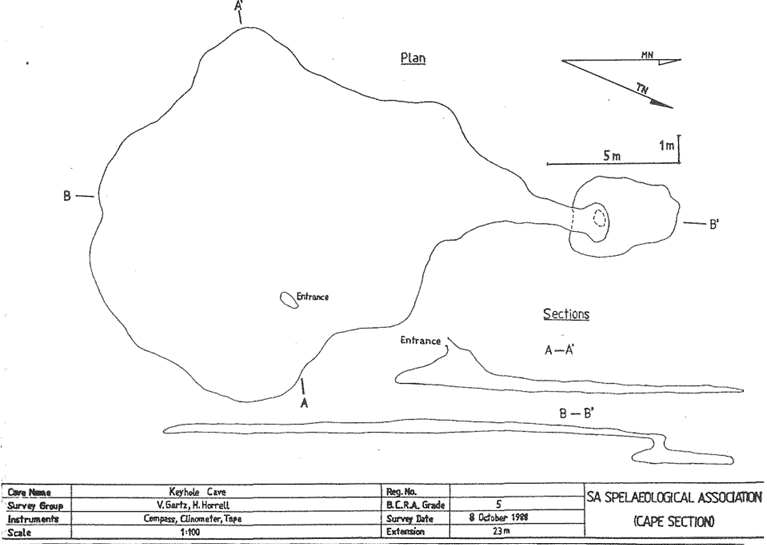
The cave is entered through a relatively small hole which leads straight into the main chamber of the cave. The chamber has a roundish shape (approximate diameter is about ten metres) although towards the northern end of the cave there is a passage which continues (via a little hole - just how little we were to find out) into another chamber which is at a lower level than the main chamber. The whole cave is low (on average about 0.4 metres high) and must be negotiated by crawling.
The cave was surveyed in October 1988 by Hamish Horrell and myself; and for the better part of two hours we battled to get from that narrow passage through the hole and into the lower chamber. The first approach was sliding into the passage feet first and on the belly. This was not successful so then we decided to slide in on the back, feet first. This resulted in the “back-breaker" position and it did not get us anywhere either. The next option was head first (which had been my idea) and so there I was, hanging upside down with my head inside the little chamber but not being able to get into the chamber any further due to the awkward geometry of the passage and the hole. "Hamish, I think my shoulders are too wide, I can’t fit through.”
The reply that I got from Hamish, who by this time was almost asleep in the passage, was something like: “You just wish your shoulders were too wide. Well, they are not, so keep trying." Good for my ego! After spending five to ten minutes in the upside down position I got a bit dizzy and decided to retreat. Even after some slight cave modification (the rock was hard and trying to hit the chisel was itself a matter of luck) we could still not get into the little chamber. The "enormous" size of that hole made us chose the name “Keyhole Cave". The actual survey of the cave was completed in about half an hour.
Survey Plans
-
Key Hole Cave[Survey][19981008][23m][5].png