Binocular Pot Cave
V.H.Gartz, BULLETIN OF THE SOUTH AFRICAN SPELEOLOGICAL ASSOCIATION (1989) 30.
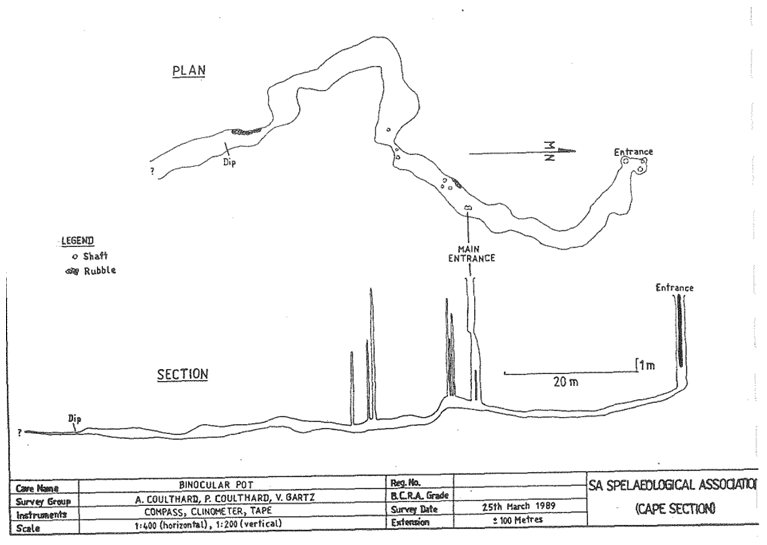
The name “Binocular Pot" is perhaps a misnomer because although the main entrance consists of two parallel shafts, there are also a number of other entrances to that cave. “Polynocular Pot" might be a better name for the cave which is situated on the De Hoop Nature Reserve near Cape Agulhas. The dense fynbos makes it difficult to locate the cave entrances, one of which is occupied by a beehive. Caution therefore has to be exercised when visiting the cave.
The cave was surveyed in March 1989 by Aidan and Paul Coulthard and myself. The twin entrance shaft is 10 m deep; but once down the ladder the cave can be comfortably negotiated by crawling. The entrance shaft enters the cave towards the lower end of the original stream passage. The northern part of the passage ends in the beeguarded entrance; and we therefore surveyed this short stretch last.. The other part of the passage extends towards the opposite direction, and winds its way on through the carbonate rock. The floor of the cave is undulating and is covered with mud (uckily fairly dry mud). Generally the passage is wider than it is high, the average width and height being about 3 m and 0.5 m respectively. Towards the western end of the cave the passage eventually becomes so low that if any further progress is to be made, a dig is necessary. This should not prove too difficult because it is only mud which would have to be removed.
While the survey team was busy with its task, a horde of five female cavers approached from behind. This was to our detriment since they overtook us and pushed on ahead. However, they were close to the end of the cave; and none of them felt like going through the "dip" (where, if you are claustrophobic you would panic; if you are too well padded you would get stuck; and if you are anywhere normal sanity you would definitely not go through). The result was that a short while after they had passed us, they were on their way back (trying their utmost to overrun us), I had to exhale in order to fit through the "dip” (and I am not very fat), The passage from then on was very low, and continued for at least another 10 metres. This no doubt could be extended if the mud were dug away. The total extent of the cave is +100 metres at present and, like so many other caves in that area, contains numerous near-cylindrical vertical shafts which extend upwards towards the surface. Some of the shafts reach the surface while others do not. A variety of bones also litters the floor of the cave which is quite short. The only two obstacles to visiting are finding it, and the bees.
Survey Plans
-
Binocular Pot Cave[Survey][19890325][100m][5].png