Leopard Skull Cave
| Field | Detail |
|---|---|
| Dimensions | Exntenion: 83 m; Height 14 m |
| Rock | Table Mountain Sandstone |
Description
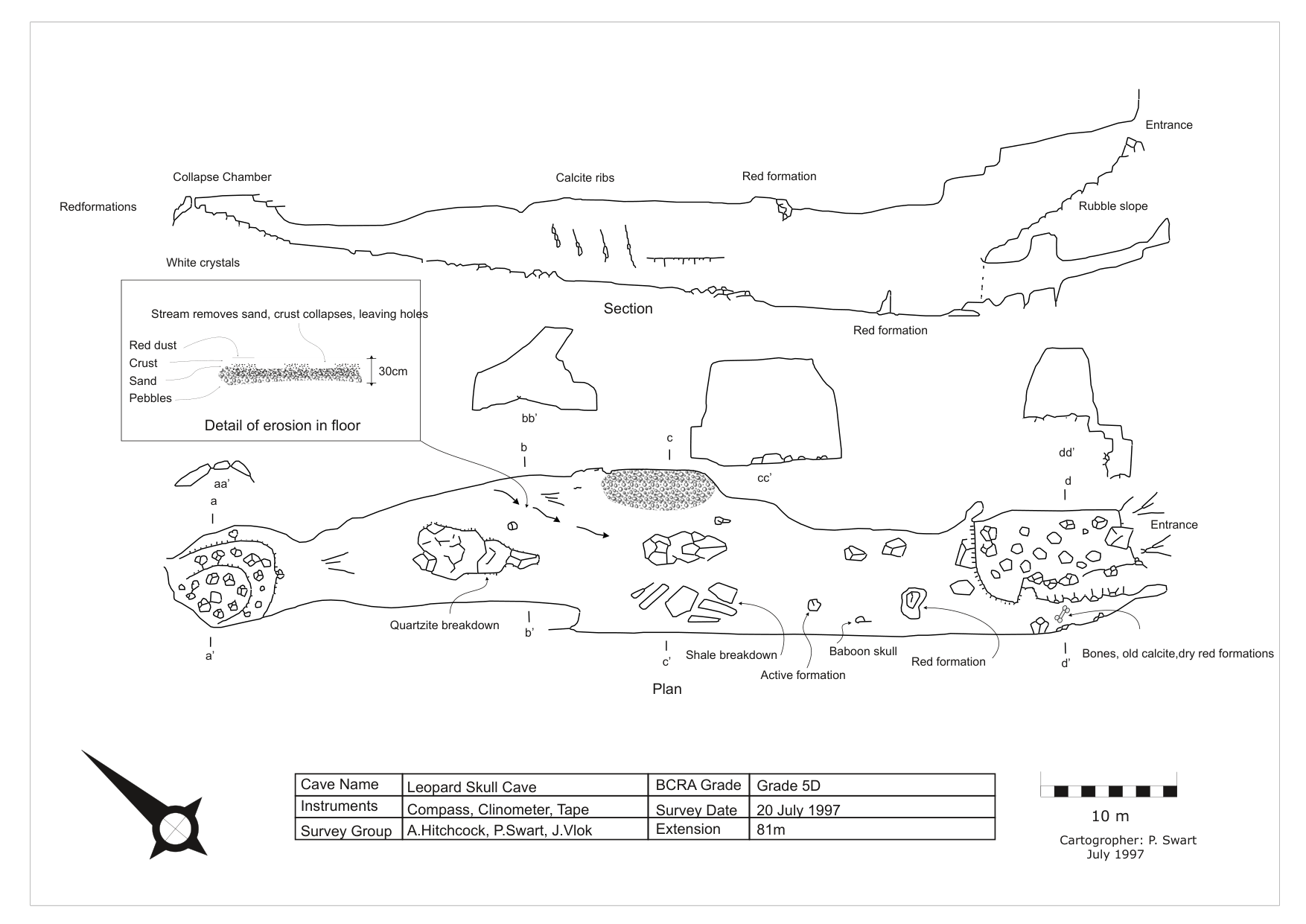
Leopard Skull Cave is an 80 m long passage, which tapers from about 10 m wide and 12 m high at the entrance, to a small chamber 2 m high by 3 m wide at the end furthest from the sea. The roof section of the old entrance has collapsed and filled the passage with rubble, leaving only a low, wide slot as the current entrance. This entrance is typical of sea caves where the roof of the entrance has collapsed.
The floor of the main passage is littered with material that has fallen from the roof. This is concentrated in two main piles of quartzite rubble running down the centre of the passage, and a pile of soft, red shale plates next to the western wall. A layer of damp, red dust covers most of the floor of the cave. The dust and the shale are very similar in colour, and the dust is probably derived from the same material as the shale.
The ceiling of the terminal chamber has collapsed, leaving a pile of rubble on the floor. The main features of this chamber are the tall, red formations, some of which hang from the walls, while others form stout stalagmites and columns. Some of the rocks are encrusted with small white crystals.
There are a number of small potholes in the floor towards the back of the cave. The holes are about 30 cm across and 20–30 cm deep, and reveal the structure of the cave floor. The topping is a thin layer of red dust that covers a layer of beach sand. The top of the beach sand layer has become quite crusty, while embedded in the bottom of the sand is a layer of small, rounded beach pebbles.
Decorations
The most interesting aspect of this cave is the variety of mineral formations which occur. These range from small white crystals on the floor, to long calcite ribs, and wide pillars of red clay.
At the base of the entrance collapse is a large boulder covered in white crystals, which are probably gypsum. Although a layer of red dust hides most of these, they are visible on the vertical surfaces of the rock, and in places where the dust has been disturbed.
A small breakdown passage was left between the original western cave wall and the boulders of the collapse. There is an old, dry flowstone formation in this passage, and plates of calcite on the floor. These have formed on top of the collapse material. Just above the flowstone is a large, active red formation hanging from the roof.
The eastern wall of the main passage is decorated with white and cream coloured calcite ribs, and stalactites. Some of the ribs are over 2 m long, and the stalactites that hang from an overhang on the wall have reached 50 cm in length. There is a large, dark red formation hanging from a hole in the roof, just above the decorated section of the cave.
Perhaps the most interesting formations are the pillars that occur in the terminal chamber. They are nearly 1 m wide and almost 2 m tall, and are still actively forming. They appear to consist of soft, red clay that is either iron oxide or an aluminium compound. A broken formation revealed its internal structure: a series of concentric rings of alternating hard and soft red material. For the size of the sample, it felt very light, and was probably not very dense. These may be similar to the formations found in the sea caves near Knysna (Durrheim, et al. 1994).
Biota
Due to time constraints, invertebrates were not specifically searched for and none were seen. During a previous visit (Gibbs, 1995), two spiders and two skulls were collected. One of the skulls turned out to be that of a leopard, a species which has not been seen in the Cape Peninsula for many years.
For such a large, relatively undisturbed cave, it was surprising that no bats, or evidence of bats, were found. There were many small, scattered droppings in the boulder collapse under the entrance that may have been left by small rodents, but none were seen, and no tracks were found.
Spelaeogenesis
At a time when the ocean level was higher than it is now, the surf found a weakness along a fault line, and eroded a passage into the sandstone cliff. As material from the walls and roof fell into the slot, the sea pounded the rocks into small boulders and sand. As the sea level dropped, it left the layers of pebbles and sand that can be seen in the potholes in the floor. Some time later, the roof over the entrance of the cave collapsed, and formed a high mound, which blocked the cave passage from the entrance gully. The sea has since eroded the outside of the entrance collapse, and what remains is a steep, rock and sand slope which leads down a gully to the surf.
Inside the cave, the other side of the collapse leads down to the main cave passage. The strata through which the sea has cut are clearly visible on the walls of the cave, and vary from relatively soft, eroded layers of white sandstone, to hard, angular broken quartzite.
Surface water has subsequently seeped through an overlying limestone bed and through iron-rich rock, and decorated the cave.
Survey
The iron oxide in the formations raised concerns that it might affect compass readings, so a superficial test was performed: a compass was moved around one of the larger red formations, but no significant influence was noticed, so no special techniques were used to overcome magnetic anomalies. The cave is, however, one straight tunnel, so small compass deviations would only affect the orientation of the survey, and not the general layout or shape of the drawing.
Survey Plans
Photos
![Leopard Skull Cave [Picture][Calcite formations on wall 2][19970720][PSwart]](Photos/Leopard_Skull_Cave_[Picture][Calcite formations on wall 2][19970720][PSwart].jpg)
![Leopard Skull Cave [Picture][Calcite formations on wall 3][19970720][PSwart]](Photos/Leopard_Skull_Cave_[Picture][Calcite formations on wall 3][19970720][PSwart].jpg)
![Leopard Skull Cave [Picture][Calcite formations on wall][19970720][PSwart]](Photos/Leopard_Skull_Cave_[Picture][Calcite formations on wall][19970720][PSwart].jpg)
![Leopard Skull Cave [Picture][Leopard skull Cape Point Museum][19970720][PSwart]](Photos/Leopard_Skull_Cave_[Picture][Leopard skull Cape Point Museum][19970720][PSwart].jpg)