Granite 2 Cave
| Field | Detail |
|---|---|
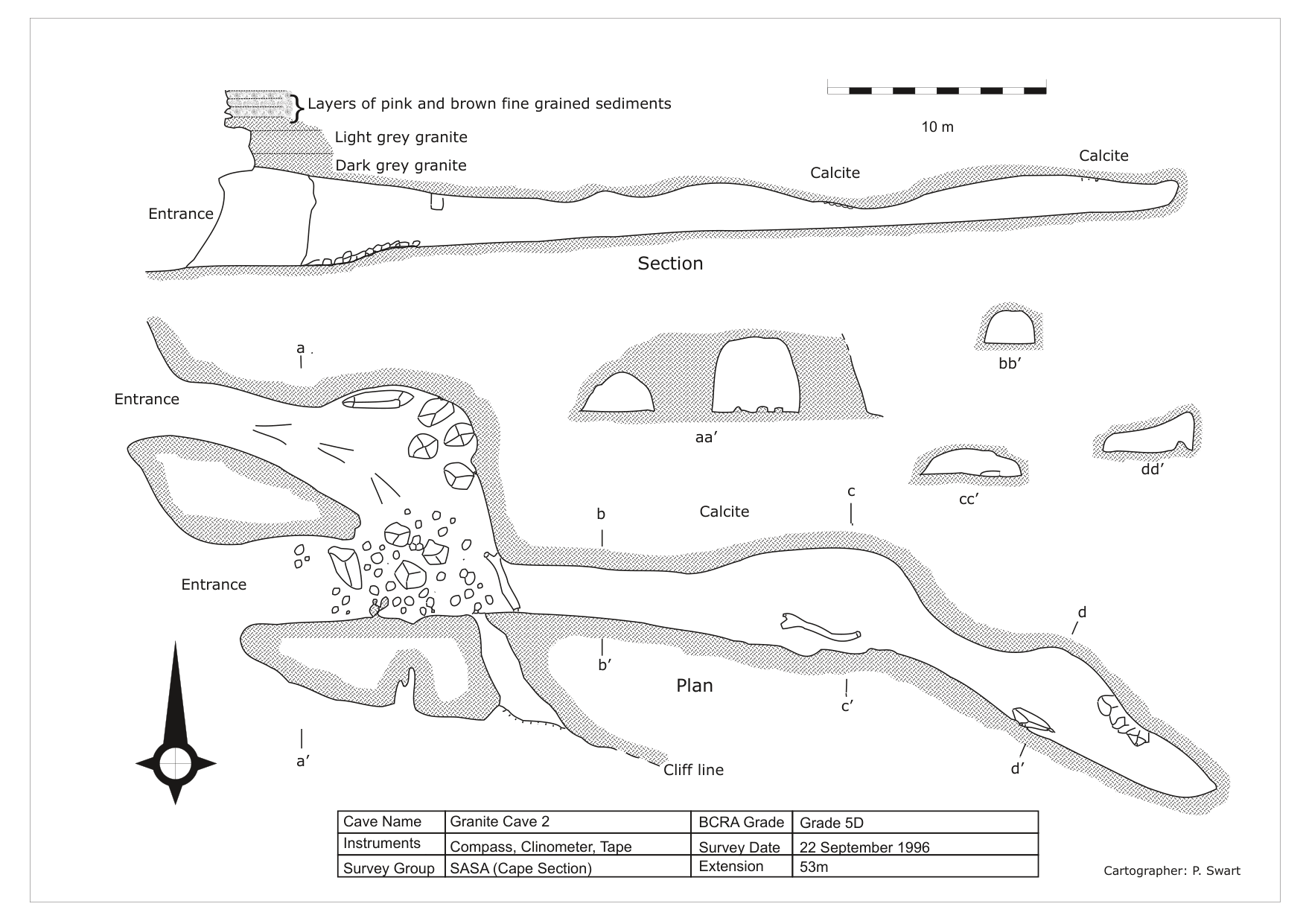
| Surveys | Survey (gif), Survey (pdf) (3.1 Meg) |
| Dimensions | Passage Length: 53 m; Box: Length 52 m, Width 10 m, Height 9 m |
| Rock | Granite |
Description
Granite Cave 2 is cut into the mainly granite base of a cliff. The cave consists of an open chamber with two entrances. This chamber leads to a low tunnel running into the cliff to the east. The passage terminates in a round-ended chamber, with a small pile of rubble near the end. The cave was formed by wave action and the joint along which the cave formed is clearly visible in the ceiling of the entrance of the cave, and along parts of the main passage. The floor of this passage is littered with small pieces of driftwood, and a large tree trunk lies across the entrance to the passage.
The cliffs above the cave are formed in quartzitic sandstone (Theron, 1984). In places, these cliffs are coated with a grey/white substance, which appears to have leached out of upper layers, and run down the sandstone, staining it white. Between the quartzitic sandstone and the granite are horizontal layers of pinkish brown, fine grained sandstone. Just above the cave is a much lighter band of granite, approximately 1 m high.
Minerals
The most obvious minerals found in the cave are a red clay-like mineral and calcite. Most of the calcite occurs in thin, wavy layers close to the ceiling of the cave. Between the calcite and the rock ceiling of the cave is a spongy layer of white crystals, which is up to 1 cm thick in places. On one wall in the twilight zone, the calcite has formed into a field of small lumps, one side of which are tinged a delicate green by algae growing on them.
The red clay could be iron oxide or possibly an aluminium compound. It occurs as light brown particles in the rock, and rusty red patches on the cave walls. Moving a compass around the material did not appear to have any effect on the readings.
Biota
There are many spiders in the cave, and other invertebrates in the entrance of the cave. Bat excrement was found on the cave floor, although no bats were seen. On the edge of the twilight/dark zone was a pile of droppings, which our guide thought might be those of a Cape clawless otter. The animal appears to have used the pile for quite some time, as the droppings at the bottom of the pile were white and dry, while those on top were still quite fresh.