Balcony Cave
| Field | Detail |
|---|---|
| Surveys | Survey (gif), Survey (pdf) (3.4 Meg) |
| Dimensions | Length: 70 m |
| Rock | Table Mountain Sandstone |
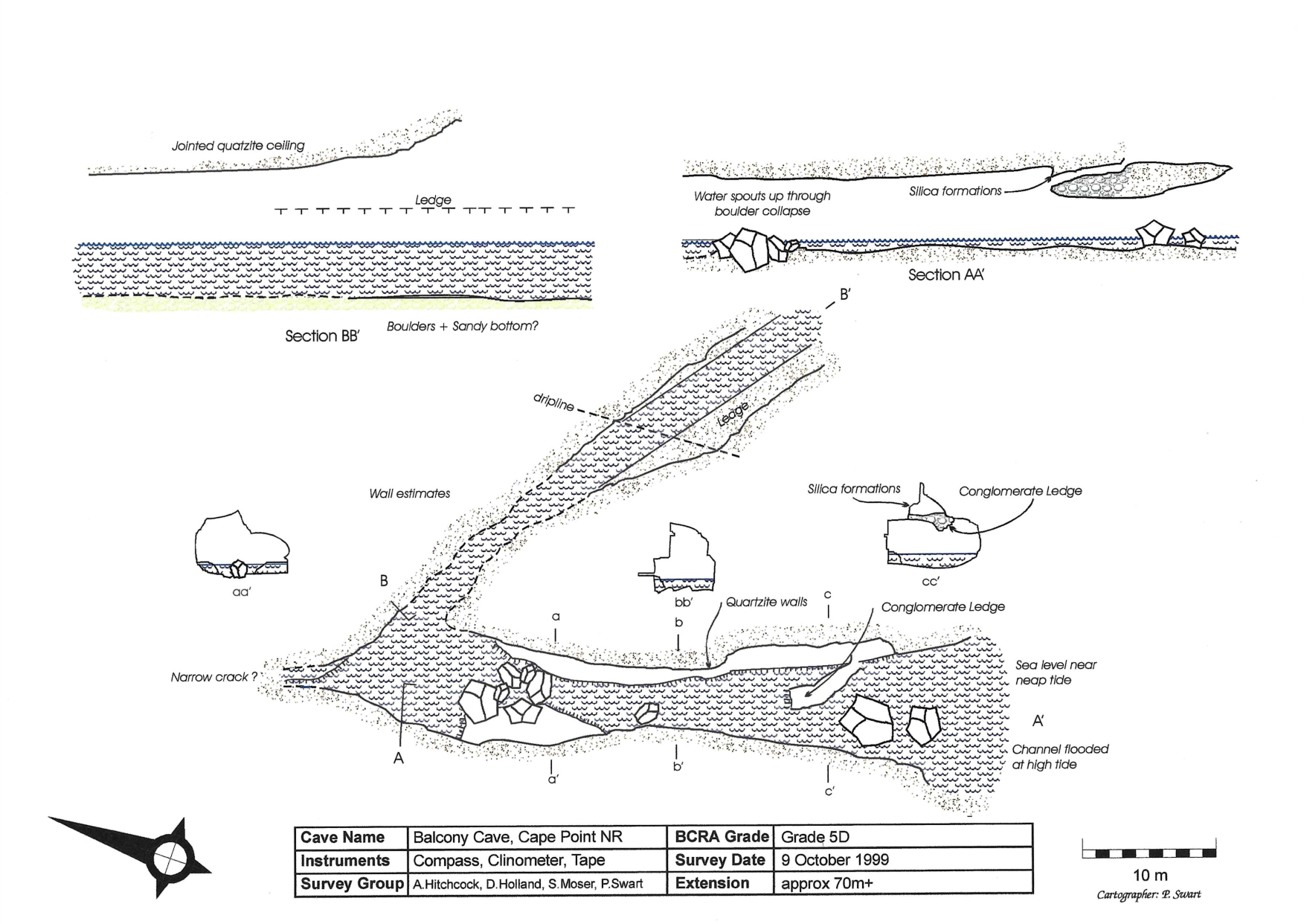
Balcony Cave lies in the northern corner of the same inlet as Thunder Cave. The cave is an active, Y-shaped sea cave. There is an entrance at the top of each of the arms of the Y, and the stem of the Y disappears into the mountain.
The southern entrance of the cave was named Balcony Cave, as there is a small passage over the top of the cave that leads to a balcony directly over the central channel. The floor of the balcony consists of well-cemented conglomerate, and the passage is well decorated with small silica formations.
The main part of the cave is the sea channel that the balcony overlooks. During low tide, the entrance of the cave is waist deep in water, and if there is no swell, it is quite easy to climb down into the cave. The entrance is full of sea urchins, and other small creatures. Further into the cave, a pile of boulders has fallen to the floor, and forms a slightly raised platform. This is as far as we could safely explore the cave. About 10 m past the boulder pile, the Balcony Cave passage meets the passage coming in from the Gallery entrance. There was a slight swell, and the waves came crashing in through the Gallery, making further progress impossible. The cave, however, appears to continue for at least another 10 m past the junction of the 2 passages. At high tide, it would be extremely dangerous to enter either entrance of this cave.
Over the entrance of Balcony Cave, close to the ceiling, is a platform of cemented rocks. This forms the balcony that gave the cave its name. There are a number of sandy nodules on the balcony that look like the silica formations found in the Kalk Bay Caves.