Koggelbeen Cave
A.N. HITCHCOCK, Extract from SASA Bulletin — 1979/80
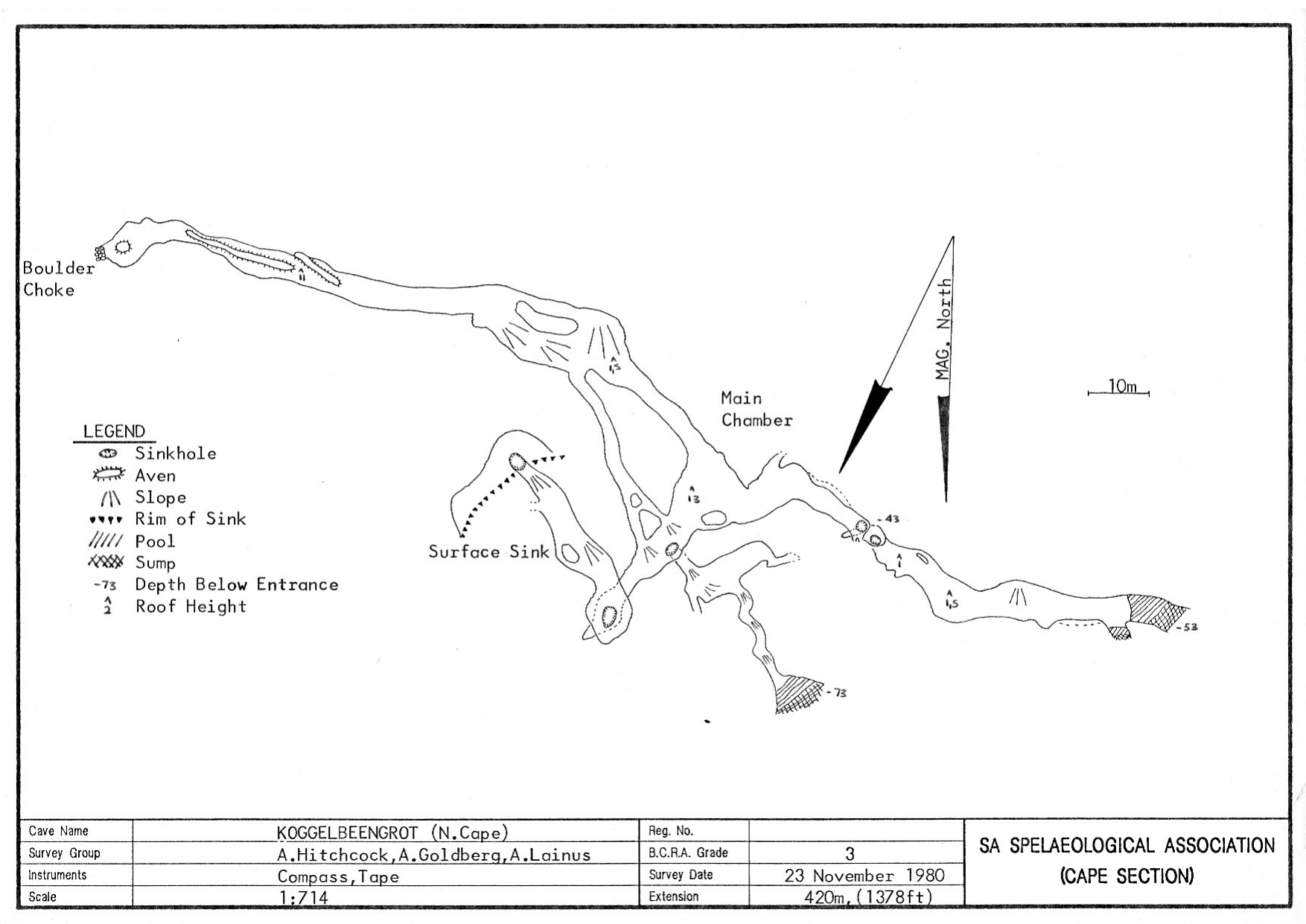
This cave is the drainage system for a large catchment basin. The terrain consists of a series of large basins each witharadiusofatleast2 kilometres. The area was surveyed from one of the surrounding koppies, butno evidence of other cave development could be seen. If any other caves do exist, they must be situated far from one another. The Koggelbeen Cave is centrally situated in its particular drainage pan; and there is a small stormwater river bed leading into it. Although it looks like a sinkhole of over 35 m. across by 10 m. deep, it more than likely was formed by swirling water action similar to the emptying of a wash basin, than by collapse.
The entrance to the cave is in the deepest corner leading steeply down at a 30° angle into a large chamber 13 m.x 13m. and about 10 m. high. From a 5m. deep hole in the floor the passage doubles under the above chamber. Thus far the floor consists of water-worn rock. A large 70 m. long passage gently slopes down averaging 13 m. high and 10 m. wide. The floor of this section of passage consists of muddy banks on the left, and river action on the right hand side. The route becomes a stomach crawl and leads toa 2,5 m. deep hole dropping into the stream bed again. The passage continues down at about 20°; and the floor again becomes bed-rock washed and rippled by water action. The passage is between 7 m.and 10 m. wideand1,5 m. high. After 71 m. the passage ends abruptly inasump. The floor of the sump does not descend any further; and the roof also levels off. The cave shows signs of continuing on the right handside and, as the passage is about 1 m. high, a diver might be able to make some progress. The total depth of this passage is 53 m. includingthe depthofthe sinkhole. The water in the sump was very warm, about 20°C.
There are two other passages of interest. One leads off to the left and gradually ascends for a total distance of 120 m. after which it becomes too narrow and collapsed. It appears to be an inlet passage, for it bears evidence of much water action. 185m. up this passage a 13 m. high aven about | m. wide runs to the end of the passage. This area of the cave is infested with a large number of unusual bats. They appear to be similar to Miniopterus schreibersi, but have pure white fur sometimes tinged with gold. The inlet passage is a bat breeding ground, as clumps of pink youngbats were either clinging to the ceiling or underneath the mothers. A white fungus was present in some places; and it was noticeable that almost all the dead bats had fallen into it.
The other passage is the more sporty and interesting. It leads down to the right and is adjacent to the inlet passage. A small passage was found leading downwards, but it was blocked. Near it asmall hole 14 was observed between the rock rubble. This was cleared; and a 1 m. hole about 2,5 m. deep led to another water-worn passage about 1 m. wide x 1 m. high, It slopes down for 17 m. at a 20° angle, and then flares out to a 12 m. wide shelf, which slopes down at 20° for 10 m. and then becomes blocked with rubble. 8 m. to the left a small 1 m. x 1 m. passage leads down sharply at a 35° and even 40° angle. This passage is water-worn and rippled, and requires sliding head first for 30 m. A small stream trickles down as well, The passage becomes slightly wider at the bottom and then levels out into a sump. A small passage runs off to the right, but after 5 m. the water blocks further progress. This could weil be the water table; but it is interesting to note the difference between the two water levels in the cave. The main passage depth was measured as being 53 m. using tape. The other passage is no less than 73 m. deep. Both these depths have been taken from the top of the sinkhole. Pure white shrimps were noticed in the pools in the lower reaches of the cave. They are larger than those found on Table Mountain. Two short-legged fat-bodied spiders were seen crawling over the young furless bats. The bats kept up a continuous vibrant movement presumably to prevent the spiders from staying in one place for any length of time.
Two trips were made into the cave on 22nd. & 23rd. November 1980 by Messrs. Anthony Hitchcock, Alan Goldberg and Andrew Lainas. The first was to explore; and the second to explore, survey and photograph. On both occasions heavy thunderstorms occurred when we were underground. On the second occasion bats were noticed to be particularly active. At the entrance, water was pouring in small rivers from every side of the sinkhole and even down the face of the cave entrance. Only a small stream could be seen entering the cave. Although the first storm lasted from Saturday evening to early Sunday morning, and heavy rain fell continuously, there was no evidence that a deluge of water had entered the cave. All members of the party wore masks because of the rumour that histoplasmosis is present in the cave. The estimated temperature was approximately 22°C. The air was very good, even though masks were worn, The only extensions possible are via the two passages ending in water; and of these the main passage can be dived whereas the other passage requires drying out before it can be pursued.
FURTHER READING
SMITH K. (1964) “A visit to the Koggelbeengrotte.” Bull. S.A. Spel. Ass. (1), 25 - 26.