Campbells Cave
Peter Swart, December 1996
Introduction
While paging though old SASA bulletins, Anthony Hitchcock came across an article (Shaw, T.R. 1962) about a cave near Richmond in the central Karoo. It was originally described by Campbell in 1815. Anthony made numerous telephone calls to people in the area, but nobody knew of the cave. Mr Peter Whitlock called back to say he had found the owner of a farm in the right area, and there was talk of a cave. Calls to both the owner, and the farmer, confirmed that the cave did exist, and that the description matched that of Campbell. Mr Viljoen, the farmer at Klipplaat, kindly agreed to let us use the old farm house as a base while in the area, and on our arrival, lead us almost to the entrance of the grotto.
Description
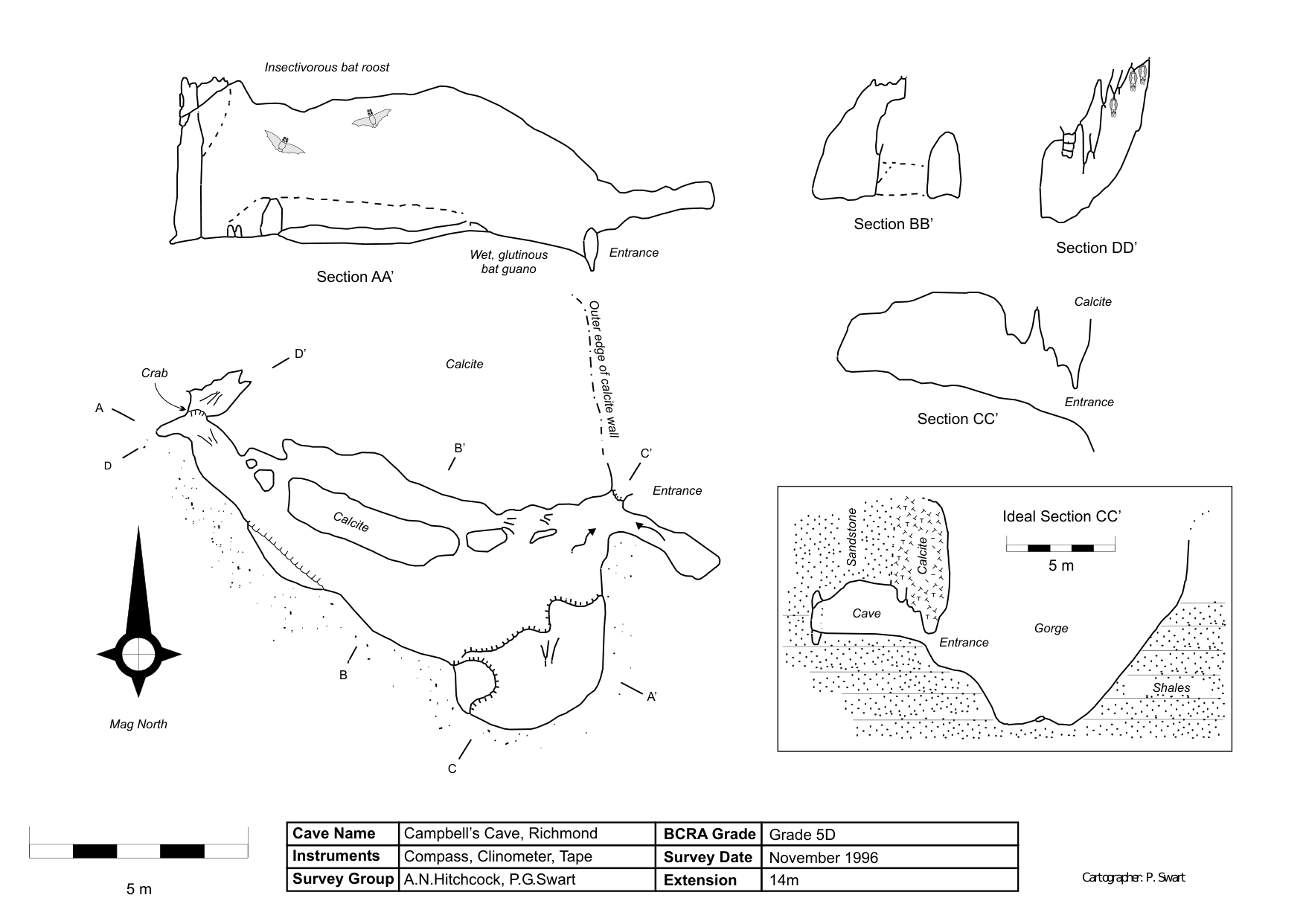
Although the cave is quite small (11 m long by 2–3 m wide by 2–4 m high), it is interesting in that it has been constructed rather than eroded. The surface topography shows the remains of an impure, thin, carboniferous layer protruding from the Karoo scrub. Below this is a 20 m–40 m deep river gorge, the walls of which are composed of thin layers of fine grained sediments, and shattered slate.
The Bakensklip River, while cutting a gorge through the sedimentary strata, eroded horizontal alcoves into the softer, brown sediments. The overlying limestone was then dissolved, and consolidated into great curtains of flowstone, which hang down into the gorge. One of these curtains closed the entrance to a horizontal shelf, and formed Campbell's Cave.
Inside the cave, the sandstone walls show evidence of erosion, with minute karren rills occurring in the softer rock, while the rest of the wall is hard, well bedded and well jointed. The outside wall is formed by cream coloured flowstone, which is over 6 m thick in places.
Biota
The cave is home to a range of animals. Large, light coloured horseshoe bats roost alongside small, dark, flat-faced bats. Although there were many bats in the cave during our visit, the farmer informed us that due to the unseasonably wet and cold weather, the population was very low for the time of year.
Some of the water from the small waterfall which runs over the entrance to the cave finds its way inside, where it forms pools and has turned the shin-deep bat guano into a glutinous quagmire. A number of aquatic creatures seem to find this environment to their liking. The most surprising was a large (12 cm diameter carapace) crab. It was making a very bad attempt at hiding in a crack. We had to climb up a very steep 5.5 m incline to get into the cave, so how the crab gained entry is anybody's guess. We also found two drab green, pointed-nosed frogs, with olive green markings, and cream stripes running from nose tip to tail.
The cracks and crevices in the sandstone wall were home to many small black spiders, none of which appeared to be dark adapted. Samples were taken to UCT for identification.
Conservation
For a cave which has been known for such a long time, there appears to be surprisingly little human damage to the cave. In its favour, the cave is far away from the general public, and access via the gorge is not easy. The local population are kept away by the dragon, which they assured us, lives in the cave, and swims in the river at night.
The farmer is renovating the farm house, with a view to renting it out as a holiday destination. Should visitors be informed of the cave, they should also be informed of the dangerous access route, and that visiting the cave will disturb the bats and could have a detrimental effect on the population.
On a subsequent visit to the cave in December 2001, we noted that although the farm house had been extensively renovated, the farmer had decided not to rent it out, so the threat of visitors was no longer as great. The bat population was much larger than on our previous visit.
Survey Plans
Photos