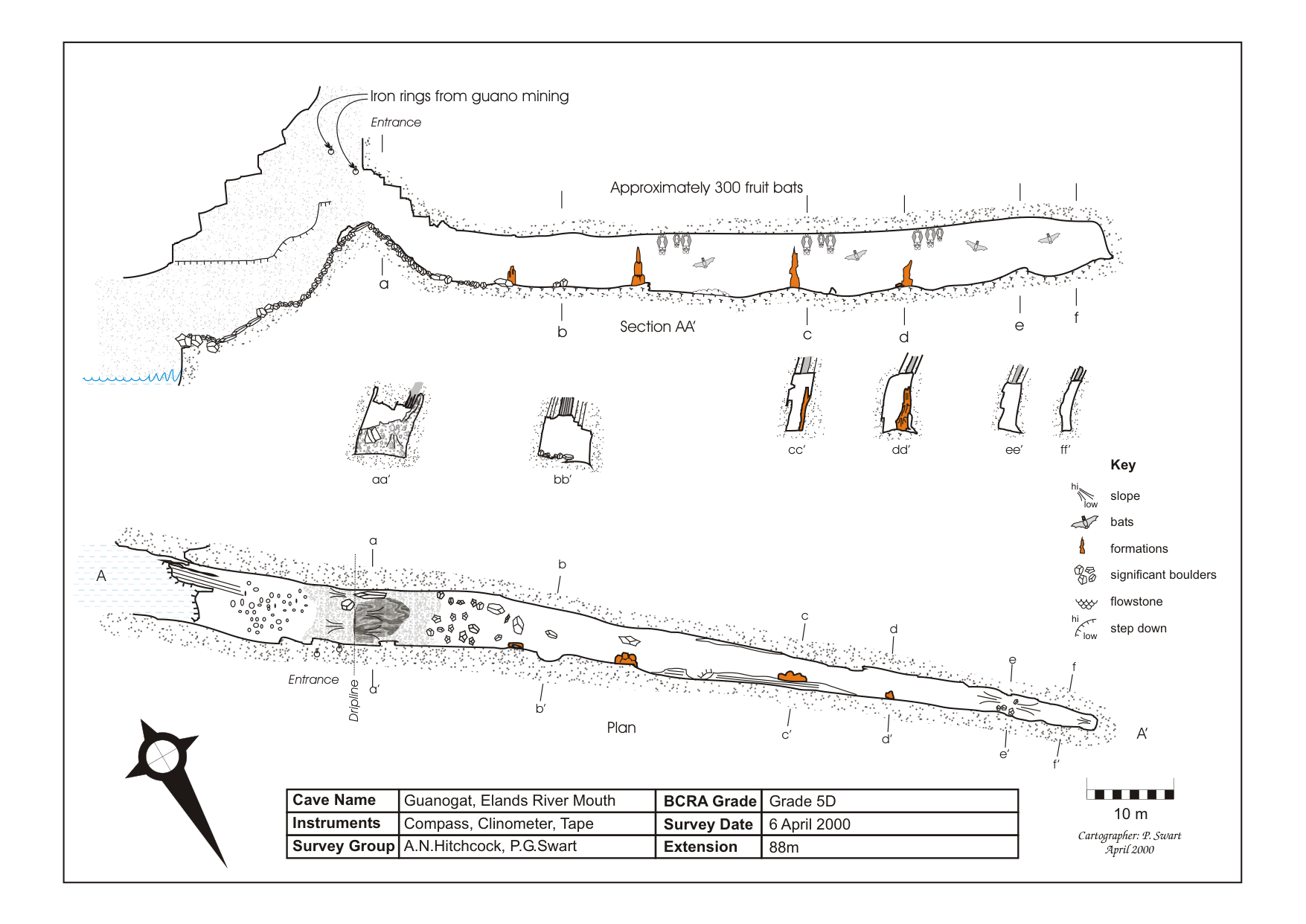
Elands River Mouth Guanogat Cave
Region: Elands River Mouth
Elandsriver Mouth
Introduction
During April 2000, a small team of Cape Peninsula Spelaeological Society members spent a week exploring and surveying caves in the area of the Elands River Mouth, near the eastern end of the park. The primary objective of the expedition was to find Guano Gat at the Elands River mouth. This cave is mentioned in a forestry report in 1927, and was mentioned by Mr John Allen of the National Parks Board. Secondary objectives were to look for new caves, and survey both new and previously visited caves.
Mr Andre Riley of the National Parks Board, and Mr. Briganza Johnson of SAFCOL were most helpful in identifying potential caving areas, and in allowing us to cross both SAFCOL and SANP land.
Elands River Mouth (ERM)
A number of visits were made to both the eastern and western sides of the Elands River Mouth. As with most of the river gorges along this coastline, the river has cut through the steeply dipping beds of the Cape Fold Belt. The direction of the river gorge is parallel to the dip of the beds and the river has exposed and enlarged fissures in these beds. All of the caves around the Elands River Mouth were formed by soft bedding layers being washed out from between harder surrounding bedding layers.
We explored 5 small caves (10m to 40m) along the eastern riverbank, and one large cave (80m) on the western bank.
Guano Cave – 80m
After thoroughly searching the eastern bank of the river without finding anything that remotely resembled a Guano Gat, we shifted our attention to the western bank.
SAFCOL gave us permission to use the forestry roads to reach the cliffs above the mouth of the river. We descended to sea level, and then clambered over the large slabs of rock that jut into the river. We finally found the cave between two of these slabs. The entrance gully has a pile of very loose rubble that has partially filled the cave entrance, and left a very loose slope leading up to the entrance, then down into the cave.
This slope leads into a large passage about 6m high by 6m wide. The cave gradually gets narrower and lower before ending about 80m from the entrance. There were about 300-400 Rosettus aegyptiacus fruit bats in the cave, many of which flew out of the cave and roosted in the surrounding cliffs until we had left. We also found a lot of wood lice and plenty of tube web spiders. We did a detailed survey of the cave and noted that guano had been removed a long time ago. There is an obvious tidemark on the wall to show how deep the guano once lay. There were also two iron pegs with ring attachments fixed to the right hand wall outside the cave, facing into the cave. Scalloping and undercutting resulting from wave action can be seen along the right hand wall facing into the cave.