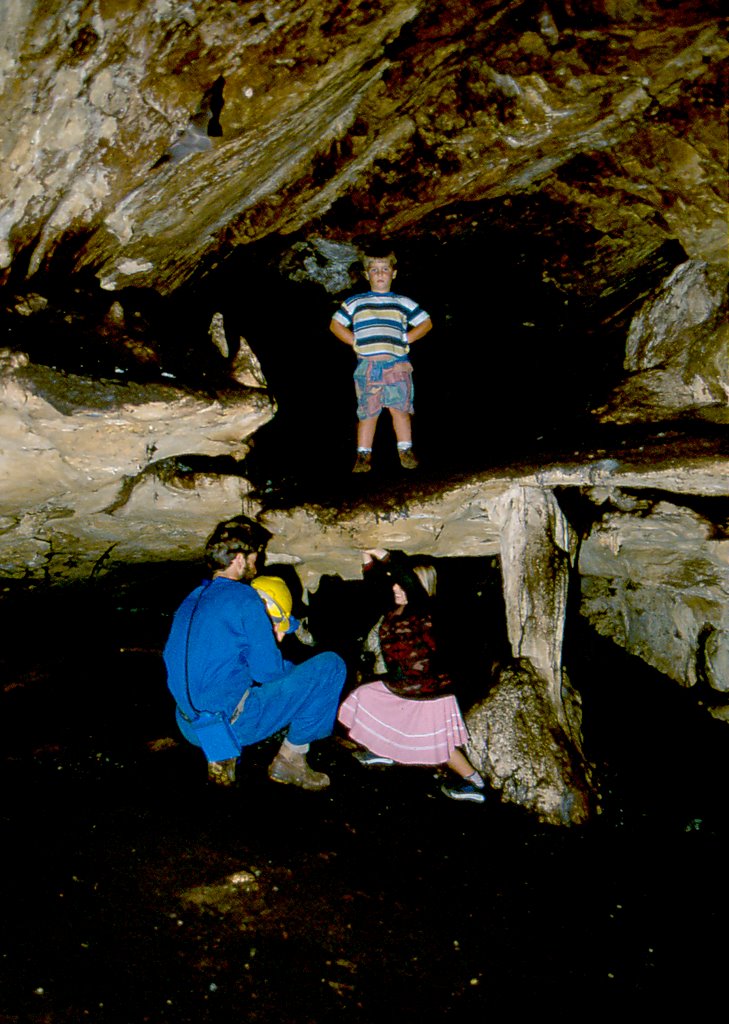
Klasies River Druipkelder Cave
Region: Caves to the East of the Tsitsikama National Park
Druipkelder, Klasies River (KRM 5) – 210m
The cave known as KRM 5 is approximately 1km to the east of KRM 1, and is approximately 19 - 20m above the current sea level. The cave has undergone a number of phases during its development, and has been flooded by the sea more than once.
The cave was initially formed when the sea broke its way through a joint in south facing beds and found a softer more soluble shale bed behind. The remnants of this softer bed can be seen as a light grey coloured band of rock running along the ceiling in a roughly north/south direction, parallel to the coast at this point. As the physical and chemical action of the sea ate away and removed the shale, the ceiling of the cave became unstable, and bedding planes peeled off and fell to floor, leaving the current triangular passage cross-section. The smaller rocks on the floor were either removed, or reduced to sand, while the larger boulders remained where they were.
The sea then went through a less violent phase during which sand was deposited in the newly formed cave. This floor was approximately 1m to 2m above the current floor level. Boulders continued to fall from the ceiling during this phase, but the sea retreated, and left the cave relatively dry for an extended period.
Once there was no longer sea action in the cave, the cave entered an era during which large calcite formations were deposited by water filtering through the calcerous sand capping above the quartzite bedrock. A large pillar, approximately 1m in diameter formed on top of a boulder resting on the sandy floor, while in places in the cave, the calcite flowed freely over the surface of the floor, and formed plates over 30cm thick.
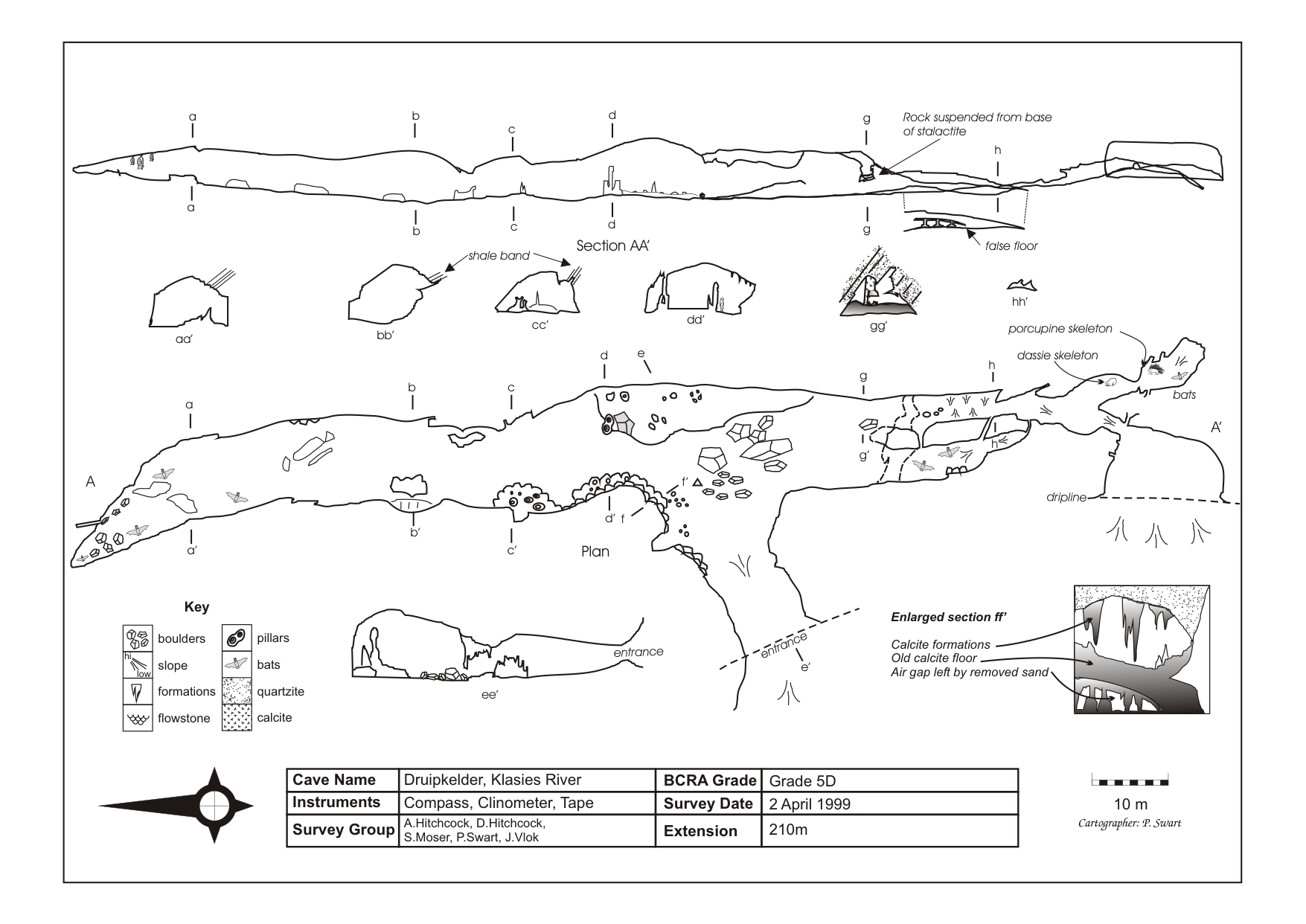
The sea, having left the cave alone for a long time, then returned, and filled the cave, eroding the calcite formations to a height of well over 2m above the current floor level. This return was however temporary, and when the sea retreated again, it removed much of the sand deposited during its previous visit. This left hanging floors of calcite, and at least one large rock suspended from a column of calcite. It is difficult to tell whether this occurred as a single era, or whether the sea rose and fell a number of times, but eventually the sea retreated to its current levels, and left the cave approximately 20m above the sea level.
Archaeology (1)
The cave has a number of deposits from both the Middle Stone Age (MSA) and the Late Stone Age (LSA). These include quartzite flake blades from the LSA, some of which are over 200mm long. These artefacts date from approximately 120kB.P. to 115kB.P.
Some of the more interesting artefacts from the LSA at KRM5 are two painted stones. One has a geometric design and the other depicts a human figure that appears to be swimming with 4 dolphins. These items appear to date from approximately 2300B.P.
Survey Plans
Photos